Partner Ecosystem Activation: How to Activate Dormant Partners and Unlock Hidden Revenue
Table of Contents
The Activation Problem: Why Most Partner Ecosystems Underperform
What Partner Ecosystem Activation Actually Means
Why Partners Stay Dormant
The Activation Framework: How to Activate Dormant Partners
Activation vs Enablement: Why Most Strategies Fail
The Revenue Impact of Partner Ecosystem Activation
Making Partner Activation Scalable
FAQs
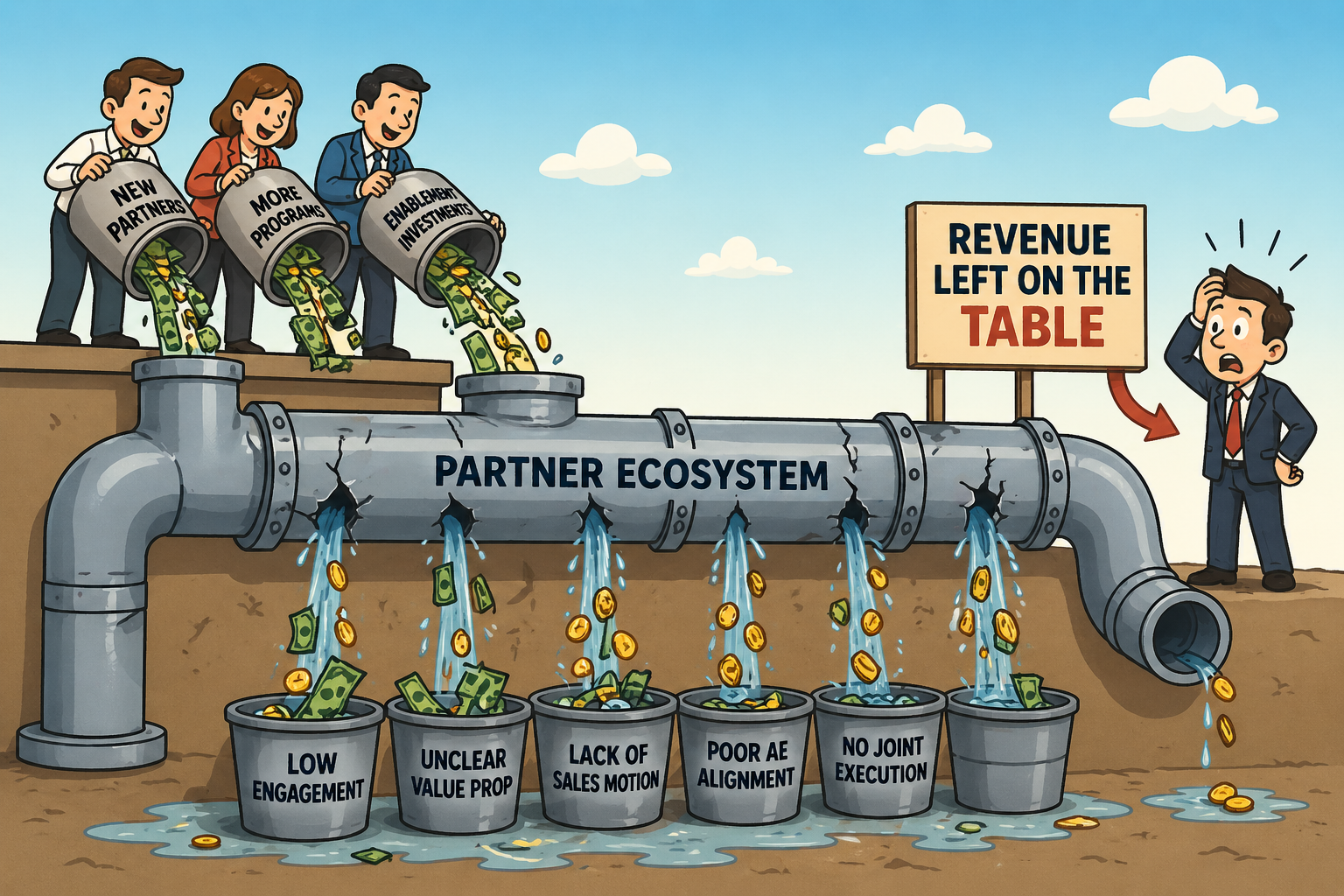
Your partner ecosystem has 150 partners. Maybe 10 are actually driving pipeline.
The instinct is to recruit more.
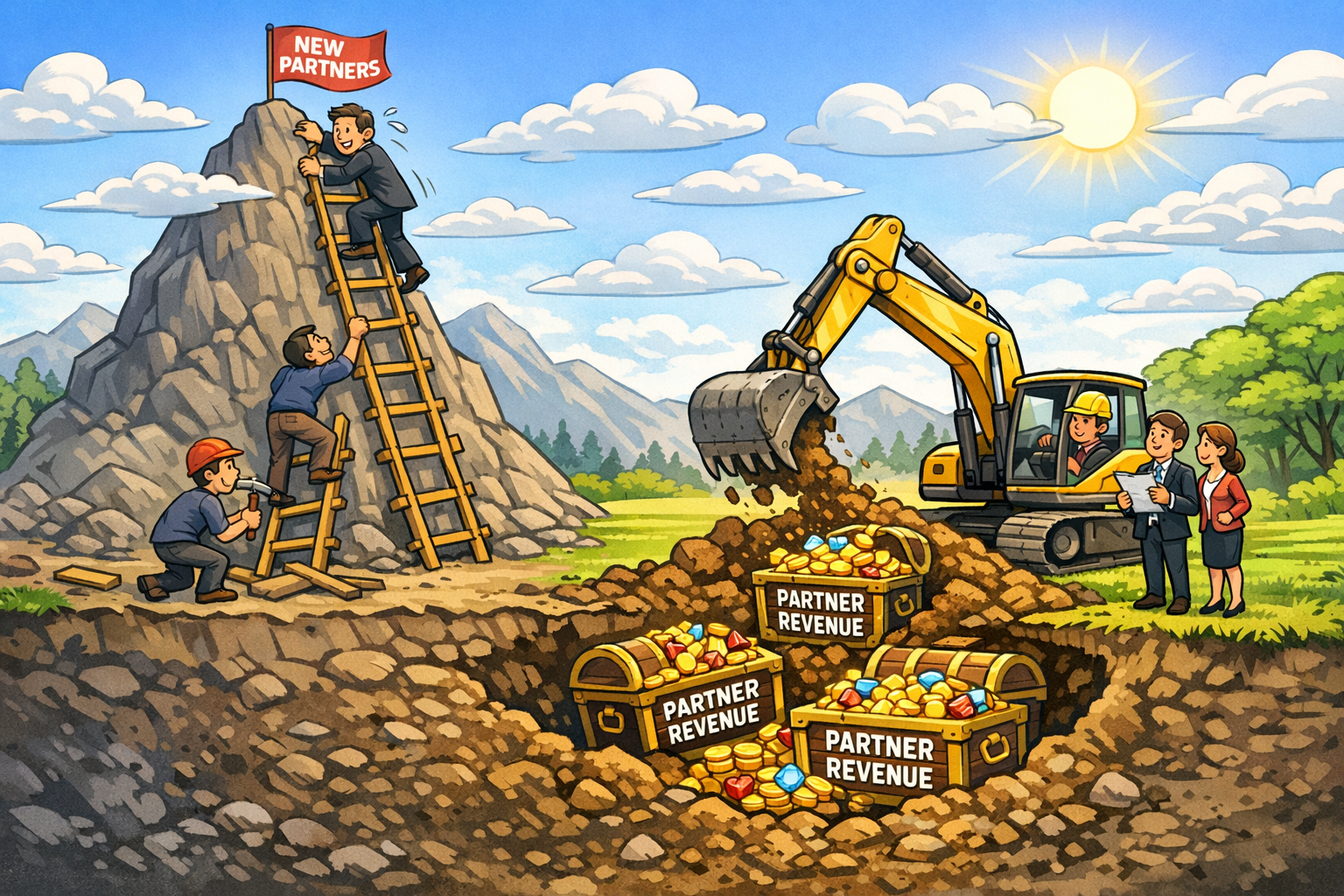
But the real opportunity isn’t expansion. It’s activation.
Because the fastest way to grow partner-driven revenue isn’t finding new partners. It’s activating the ones you already have—especially the dormant ones sitting in your ecosystem with unrealized potential.
That’s the role of partner ecosystem activation.
The Activation Problem: Why Most Partner Ecosystems Underperform
Most ecosystems are built for scale—but not for performance.
You invest in:
Partner recruitment
Portals and onboarding
Certifications and training
The ecosystem grows. The partner count looks impressive. Revenue doesn’t follow.
Why?
Because most partner programs optimize for coverage, not activation.
They assume that if partners are:
Enabled
Certified
Given access
They will naturally sell.
They don’t.
The result is predictable:
A small percentage of partners generate most revenue
A large percentage remain inactive or underutilized
Internal teams focus only on top partners
The rest become dormant—not because they lack capability, but because they were never activated.
What Partner Ecosystem Activation Actually Means
Partner ecosystem activation is the process of turning inactive or underutilized partners into revenue contributors.
It is not onboarding.
It is not enablement.
It is not engagement.
Activation means:
A partner has a clear role in a deal
A partner has a defined use case and offering
Sales teams know when and how to bring them in
The partner actually influences or drives revenue
Activation is measurable.
If it doesn’t change pipeline or revenue, it’s not activation.
Why Partners Stay Dormant
Dormant partners are not a partner problem. They’re a design problem.
Across ecosystems, the same failure points show up repeatedly.
No Clear Use Case
Partners don’t know where they fit.
Without a defined:
Customer problem
Entry point
Scenario for engagement
They remain invisible to sales teams.
Weak Go-To-Market Packaging
Partners may have strong delivery capability but lack:
Productized offerings
Clear messaging
Repeatable sales motions
Raw capability doesn’t sell. Packaged solutions do.
No Sales Alignment
Even strong partners fail without alignment to internal sellers.
Sales teams don’t:
Understand partner value
Trust when to engage them
See how they accelerate deals
So they default to what they know—selling without partners.
Misplaced Focus on Top Partners
Most ecosystems concentrate resources on the top 10%.
That creates:
Overdependence on a small group
Neglect of mid-tier partners
Limited scalability
The real growth opportunity sits in the middle—not the top.
The Activation Framework: How to Activate Dormant Partners
Activating dormant partners requires a shift from enablement to execution.
1. Identify High-Potential Dormant Partners
Not all dormant partners should be activated.
Focus on partners with:
Relevant customer experience
Industry or ICP alignment
Existing but underutilized capability
Activation is about unlocking potential—not creating it from scratch.
2. Define a Sales Motion
Every partner needs a clear path into a deal.
This includes:
Specific use case
Target customer
Entry point in the sales cycle
Defined value to the seller
Without this, partners remain theoretical—not usable.
3. Package the Offering
Partners must move from capability to clarity.
This means:
Named solutions
Clear outcomes
Defined scope
Packaging reduces friction and increases seller confidence.
4. Enable Internal Sellers
Most activation strategies fail here.
Partners don’t drive deals—sales teams do.
Activation requires:
Seller awareness
Seller trust
Seller adoption
If internal teams don’t bring partners into deals, activation never happens.
5. Drive Early Wins
Activation is reinforced through success.
Focus on:
High-probability opportunities
Tight alignment between teams
Fast execution
Early wins create repeat behavior and momentum.
Activation vs Enablement: Why Most Strategies Fail
Most partner programs confuse enablement with activation.
Enablement is passive.
It gives partners access to:
Training
Content
Certifications
Activation is active.
It creates:
Defined motions
Deal participation
Revenue outcomes
Enablement assumes partners will act. Activation ensures they do.
This is why many ecosystems feel busy but don’t produce results.
They’re enabled—but not activated.
The Revenue Impact of Partner Ecosystem Activation
When partner ecosystem activation is done correctly, the impact is direct and measurable:
Increased partner-sourced pipeline
Higher win rates
Faster deal cycles
Larger deal sizes
Most importantly, it unlocks revenue that already exists within your ecosystem.
Organizations that formalize activation often structure it as a defined motion—with clear timelines, deliverables, and revenue expectations—rather than treating it as ongoing “partner management.”
That shift—from activity to outcome—is what turns ecosystems into revenue engines.
Making Partner Activation Scalable
The challenge isn’t activating one partner.
It’s activating dozens—or hundreds—without increasing headcount.
Scalable activation requires:
Clear prioritization of partners
Standardized sales motions
Repeatable activation frameworks
Intelligence to guide investment decisions
Without this, activation remains manual and inconsistent.
With it, ecosystems become predictable, scalable, and revenue-generating.
FAQs
What is partner ecosystem activation?
Partner ecosystem activation is the process of turning inactive or underutilized partners into active contributors to pipeline and revenue. It focuses on creating clear sales motions, aligning partners with internal teams, and driving measurable deal participation.
How do you activate dormant partners?
To activate dormant partners, organizations must identify high-potential partners, define clear use cases, package offerings, align with sales teams, and drive early deal success. Activation requires execution—not just enablement.
What’s the difference between partner enablement and partner activation?
Partner enablement provides resources like training and content. Partner activation ensures those partners actually participate in deals and generate revenue. Enablement is passive; activation is outcome-driven.
Why do most partners remain dormant?
Most partners remain dormant due to unclear use cases, weak GTM packaging, lack of sales alignment, and over-focus on top partners. The issue is usually structural—not capability-related.
What are the benefits of partner ecosystem activation?
Effective partner ecosystem activation leads to increased pipeline, higher win rates, faster sales cycles, and improved ROI from existing partners. It turns underutilized relationships into revenue drivers.
How long does it take to activate partners?
With a structured approach, early activation results can occur within 30–60 days. Full activation across a broader partner set typically takes longer depending on ecosystem size and maturity.
Is partner activation better than recruiting new partners?
In most cases, activating existing partners is faster and more cost-effective than recruiting new ones. Existing partners already have relationships, context, and capabilities that can be unlocked with the right activation strategy.
If you want to take this further, the next move isn’t another article—it’s building a content cluster around this (activation → readiness scoring → sales alignment → mid-tier partners) so you dominate the category instead of just competing in it.
The Hidden Cost of Inactive Partners: Calculate Your Revenue Upside in 2026
Table of Contents
The Problem Hiding in Plain Sight
What Inactive Partners Really Cost Your Business
The Partner Revenue Upside Calculator Framework
Breaking Down the Numbers: Real-World Examples
Why Most Partnership Teams Can't See the Revenue Gap
Building Your Business Case for Partner Activation
The Cost of Waiting Another Quarter
FAQs
Conclusion
The Problem Hiding in Plain Sight
Your partner list looks impressive. 200, 300, maybe 500 partners enrolled in your ecosystem. But here's the question your CRO is asking: how many of those partners actually generated revenue last quarter?
If you're like most B2B SaaS companies, the answer is uncomfortable. Maybe 15-20% of your partners drove any meaningful revenue. The rest? They're sitting dormant, collecting dust in your partner portal while you chase new partner acquisitions.
This isn't a partner quantity problem. It's a partner activation problem. And it's costing you millions in revenue that's already within reach.
What Inactive Partners Really Cost Your Business
Most partnership leaders think about inactive partner cost wrong. They see dormant partners as neutral—not helping, but not hurting either. That's a costly mistake.
Inactive partners represent opportunity cost at scale. Every dormant partner relationship is revenue sitting on the table, waiting for activation. When you multiply that across your entire ecosystem, the numbers become staggering.
The Three Hidden Costs of Partner Inaction
Acquisition Cost Waste: You invested time, resources, and often direct costs to recruit each partner. When they sit inactive, that investment generates zero return. For most B2B SaaS companies, partner acquisition costs range from $2,000 to $15,000 per partner when you factor in sales time, marketing spend, and onboarding resources.
Competitive Revenue Loss: Your inactive partners aren't just sitting still—they're actively working with your competitors. Every month they remain dormant in your ecosystem is another month they're driving revenue for someone else.
Compound Growth Impact: Partner-sourced revenue typically grows faster than direct sales revenue due to shorter sales cycles and higher close rates. When you leave partners inactive, you're not just missing this quarter's revenue—you're missing the compound growth that partner revenue delivers.
The Partner Revenue Upside Calculator Framework
Here's how to calculate what your inactive partners are actually costing you. This framework gives you the data you need to build a compelling business case for partner activation.
Step 1: Baseline Your Current Partner Performance
Start with these core metrics:
Total partners in your ecosystem
Partners who generated revenue in the last 90 days
Average revenue per active partner (quarterly)
Average deal size from partner-sourced opportunities
Step 2: Calculate Your Activation Potential
Not every inactive partner is worth activating. Focus on partners who show readiness indicators:
Recent engagement with your content or portal
Existing customer overlap in their portfolio
Market presence in your target segments
Previous revenue generation (even if dormant now)
A realistic activation rate for dormant partners ranges from 25-40% depending on your approach and partner quality.
Step 3: Apply the Revenue Upside Formula
Basic Revenue Upside = (Activatable Partners × Average Partner Revenue × Activation Rate) - Current Partner Revenue
Let's walk through a real example:
Total partners: 400
Currently active partners: 80 (20%)
Inactive but activatable partners: 120 (30% of total)
Average quarterly revenue per active partner: $25,000
Realistic activation rate: 35%
Calculation:
Potential new active partners: 120 × 0.35 = 42 partners
Additional quarterly revenue: 42 × $25,000 = $1,050,000
Annual revenue upside: $4,200,000
Step 4: Factor in Growth Multipliers
Partner revenue typically compounds faster than direct sales. Apply these multipliers to your base calculation:
Year 1: Base calculation
Year 2: Base × 1.4 (40% growth from relationship maturity)
Year 3: Base × 1.8 (partner ecosystem effects kick in)
Breaking Down the Numbers: Real-World Examples
Mid-Market SaaS Company ($20M ARR)
Current State:
250 total partners
45 active partners (18%)
$15,000 average quarterly revenue per partner
85 partners identified as activatable
Revenue Upside Calculation:
Potential activations: 85 × 30% = 26 partners
Additional quarterly revenue: 26 × $15,000 = $390,000
Annual upside: $1,560,000
Three-year compound value: $4,290,000
The Reality Check: This company is leaving $1.5M+ on the table annually by not activating dormant partners. That's nearly 8% of their total ARR sitting unused in their ecosystem.
Enterprise SaaS Company ($50M ARR)
Current State:
180 total partners
32 active partners (18%)
$45,000 average quarterly revenue per partner
54 partners identified as activatable
Revenue Upside Calculation:
Potential activations: 54 × 35% = 19 partners
Additional quarterly revenue: 19 × $45,000 = $855,000
Annual upside: $3,420,000
Three-year compound value: $9,396,000
The Bottom Line: Nearly $3.4M in annual revenue is sitting dormant in their partner ecosystem—equivalent to hiring 15-20 additional sales reps.
Why Most Partnership Teams Can't See the Revenue Gap
The problem isn't that partnership leaders don't care about inactive partners. The problem is visibility.
Most partner relationship management systems show you enrollment numbers, not readiness scores. They track partner onboarding completion, not revenue potential. They measure activity, not activation readiness.
Without clear visibility into which partners are ready and capable of generating revenue, partnership teams default to spray-and-pray activation tactics. Mass emails to all partners. Generic enablement content. One-size-fits-all outreach campaigns.
These approaches fail because they treat all inactive partners the same. But partners go dormant for different reasons:
Lack of training or enablement
No clear go-to-market fit
Internal resource constraints
Competing priorities with other vendors
Missing incentive alignment
Effective partner activation requires understanding why each partner is inactive and addressing the specific barriers preventing them from generating revenue.
Building Your Business Case for Partner Activation
When you present your revenue upside calculation to leadership, frame it around three key points:
Investment vs. Return
Partner activation delivers significantly higher ROI than new partner acquisition. Activating existing partners costs 60-80% less than recruiting new ones, with faster time-to-revenue.
Risk Mitigation
Diversifying your revenue sources through partner activation reduces dependence on direct sales and creates more predictable revenue streams.
Competitive Advantage
Companies that effectively activate their partner ecosystems grow 2.5x faster than those focused solely on direct sales expansion.
The Business Case Template
Problem Statement: "We have [X] inactive partners representing $[Y] in potential annual revenue. Our current 20% partner activation rate is below industry benchmarks of 35-45%."
Opportunity: "Activating just 30% of our dormant partners would generate an additional $[Z] in annual revenue with minimal incremental investment."
Investment Required: "Partner activation requires [specific resources/tools] with an estimated cost of $[amount], delivering [ROI percentage] return in the first year."
Timeline: "We can begin seeing revenue impact within 90 days, with full activation benefits realized over 12-18 months."
The Cost of Waiting Another Quarter
Every quarter you delay partner activation, the opportunity cost compounds. Partners who could be generating revenue today will take 90-120 days to fully activate once you begin the process.
But there's a hidden cost beyond delayed revenue: partner attrition. Inactive partners don't stay in your ecosystem forever. They eventually formal partnerships with competitors or deprioritize your market segment entirely.
The partners sitting dormant in your ecosystem today represent the easiest revenue growth opportunity you have. They already know your product. They've already committed to your partnership. They just need activation.
Your best revenue is already in your ecosystem. You just can't see it yet.
Ready to calculate your specific partner revenue upside and build your activation strategy? Learn more at getprtnrd.com.
FAQs
How do I identify which inactive partners are worth activating?
Look for partners with recent engagement signals, customer overlap, market presence in your target segments, and previous revenue history. Partners showing 2-3 of these indicators typically have 40-60% activation success rates.
What's a realistic timeline for seeing revenue from activated partners?
Most activated partners begin generating revenue within 60-90 days, with full revenue potential realized over 6-12 months. Partners with existing customer relationships often move faster.
How much should I invest in partner activation versus new partner recruitment?
The optimal ratio depends on your ecosystem maturity, but most successful B2B SaaS companies allocate 60-70% of partnership resources to activation and 30-40% to new partner acquisition.
What if my inactive partners don't respond to activation outreach?
Non-responsive partners often indicate deeper issues like misaligned incentives or resource constraints. Focus your activation efforts on partners showing engagement signals rather than broadcasting to your entire inactive list.
How do I measure the success of partner activation initiatives?
Track activation rate (percentage of targeted partners who begin generating revenue), time-to-first-deal, and revenue per activated partner. Set realistic benchmarks: 25-35% activation rates are typical for well-executed programs.
Can partner activation work if I don't have dedicated partnership resources?
Yes, but it requires systematic prioritization. Focus on your top 20-30 inactive partners with the highest revenue potential rather than trying to activate your entire dormant ecosystem simultaneously.
What's the biggest mistake companies make with partner activation?
Treating all inactive partners the same. Successful activation requires understanding why each partner is dormant and addressing specific barriers to their success, not generic mass outreach campaigns.
Conclusion
The math is clear. Your inactive partners represent millions in accessible revenue that requires no new customer acquisition, no additional product development, and no market expansion.
The question isn't whether you should activate your dormant partners. The question is how much longer you can afford to leave that revenue on the table.
Start with the calculation framework above. Identify your revenue upside. Build your business case. Then take action on the growth opportunity sitting right in your partner ecosystem.
The State of Partner Ecosystems in 2026: Data-Driven Insights for Channel Leaders
Table of Contents
The Reality Behind Partner Program Performance
2026 Partner Ecosystem Benchmarks
The Dormant Partner Crisis
Revenue Attribution and Measurement Challenges
Partner Readiness and GTM Capability Gaps
Technology Stack Evolution
Budget and Resource Allocation Trends
What High-Performing Programs Do Differently
Looking Ahead: 2026 Predictions
FAQs
Your partner ecosystem holds millions in untapped revenue. But most partnership leaders can't see it.
The data tells a harsh story. While 2026 marks a year of unprecedented investment in partner programs, the majority of B2B companies are sitting on dormant partner networks that could double their pipeline overnight. The problem isn't visibility or management tools. It's intelligence.
This comprehensive analysis examines partner ecosystem performance across hundreds of B2B SaaS companies, revealing the uncomfortable truths about partner program ROI and the specific strategies that separate high performers from the rest.
The Reality Behind Partner Program Performance
Partnership leaders face mounting pressure in 2026. CROs demand measurable channel ROI while partner-sourced revenue targets climb higher each quarter. The disconnect between expectation and execution has never been wider.
The average B2B SaaS company manages 847 partners but actively works with only 23% of them. This statistic alone reveals the core challenge facing partnership teams: scale without focus leads to resource waste and missed opportunities.
Partnership programs have grown faster than teams can manage them. The typical VP of Partnerships oversees 15x more partners than their team can realistically nurture. Manual partner management breaks down at this scale, leaving hundreds of capable partners dormant while teams chase the same 20 active relationships.
The pressure intensifies when you consider that partner-sourced revenue now represents 28% of total bookings for the average B2B SaaS company. Missing on partner program performance directly impacts company-wide revenue targets.
2026 Partner Ecosystem Benchmarks
Understanding where your program stands requires clear benchmarks. Here's what the data shows across different company stages and sizes:
Partner Portfolio Size by Company Stage
Series D companies: Average 423 partners
Series E companies: Average 712 partners
Growth-stage companies: Average 1,247 partners
Enterprise companies: Average 2,156 partners
Active Partner Engagement Rates
The definition of "active" varies, but most companies consider partners active if they've generated pipeline activity in the past 90 days:
Top quartile programs: 41% active partner rate
Average programs: 23% active partner rate
Bottom quartile programs: 12% active partner rate
Partner-Sourced Revenue Distribution
High-performing programs show dramatically different revenue concentration:
Top 10% of partners generate 67% of partner-sourced revenue
Next 20% generate 24% of partner-sourced revenue
Bottom 70% generate 9% of partner-sourced revenue
This distribution highlights a critical insight: most partnership teams spend equal time on all partners when they should focus heavily on the top 30%.
Channel Partnership Statistics That Matter
Pipeline velocity through partners runs 34% faster than direct sales cycles. Partners who understand your product and have established customer relationships can compress deal timelines significantly.
Partner-influenced deals close at 23% higher average contract values compared to direct sales. Partners often engage with larger accounts and can position solutions more comprehensively.
Customer retention rates improve by 18% when partners are involved in the initial sale and ongoing relationship management.
The Dormant Partner Crisis
The most significant finding in our 2026 analysis centers on dormant partners. These are ecosystem members who completed onboarding, have the right customer base, but haven't generated meaningful activity in months.
77% of partners in the average ecosystem are dormant. They're not broken relationships or poor fits. They're capable partners who lack activation.
Why Partners Go Dormant
Unclear GTM motion: Partners understand your product but don't know how to sell it effectively to their customers.
Lack of sales enablement: Generic training doesn't translate to partner-specific sales situations and customer conversations.
No accountability framework: Partners receive enablement but have no structured follow-up or performance expectations.
Resource competition: Partners represent multiple vendors and naturally focus on the relationships that provide the clearest path to revenue.
The Cost of Dormant Partners
Every dormant partner represents opportunity cost. Our revenue upside calculations show that reactivating just 15% of dormant partners typically generates $2.3M in additional pipeline within six months.
The math is straightforward: If your average partner generates $47K in annual partner-sourced revenue, and you have 650 dormant partners, you're sitting on $30.5M in potential annual revenue.
Most partnership teams focus on recruiting new partners instead of activating existing ones. This approach ignores the fact that reactivated partners generate revenue 3x faster than newly recruited partners because they already understand your product and market positioning.
Revenue Attribution and Measurement Challenges
Partnership measurement remains broken in 2026. While companies have invested heavily in attribution tools, most still can't answer basic questions about partner program ROI.
Common Attribution Problems
Multi-touch complexity: Partners influence deals they don't directly source, but most attribution models miss this impact.
Long sales cycles: Partner influence often occurs months before deal closure, making it difficult to track in traditional CRM systems.
Cross-partner collaboration: Multiple partners sometimes collaborate on the same opportunity, creating attribution conflicts.
Ecosystem Performance Data Gaps
68% of partnership leaders can't accurately calculate their cost per partner-sourced dollar. Without this metric, it's impossible to make intelligent investment decisions about partner enablement and activation.
Only 31% of companies track partner readiness scores or have systematic ways to evaluate which partners are worth investing in.
Partner program benchmarks vary wildly because companies measure different things. Some focus on partner-sourced revenue, others on partner-influenced pipeline, and many track both inconsistently.
What Gets Measured Gets Managed
High-performing programs track specific metrics that drive behavior:
Partner activation rate: Percentage of partners generating pipeline within 90 days of enablement
Revenue per active partner: Total partner-sourced revenue divided by actively engaged partners
Partner readiness scores: Systematic evaluation of GTM capability and execution maturity
Time to first deal: Average days from partner onboarding to first opportunity registration
Partner Readiness and GTM Capability Gaps
The biggest differentiator between successful and struggling partner programs isn't partner quantity or even partner quality. It's partner readiness.
Partner readiness encompasses three critical areas:
GTM Capability Assessment. Does the partner have the right sales team, processes, and customer relationships to sell your solution effectively?
Only 34% of partners demonstrate strong GTM capability when evaluated systematically. The rest have gaps in sales process, customer targeting, or solution positioning that prevent consistent revenue generation.
Sales Motion Clarity. Can the partner clearly articulate your value proposition to their customers and navigate complex sales cycles?
Partners with clear sales motions generate 4.2x more revenue than partners who struggle with positioning and objection handling.
Execution Maturity
Does the partner have proven ability to execute on opportunities and close deals in your solution category?
Execution maturity correlates directly with deal velocity and close rates. Partners with strong execution track records close deals 28% faster and at 15% higher rates.
The Readiness Scoring Advantage
Companies that systematically evaluate partner readiness make better investment decisions. Instead of spreading enablement resources equally across all partners, they focus on partners with the highest readiness scores and the greatest potential for activation.
Readiness scoring identifies which partners are worth investing in before you spend time and resources on enablement programs that won't generate ROI.
Technology Stack Evolution
The partner technology stack has evolved significantly in 2026, but most companies still have gaps in their ecosystem intelligence capabilities.
Current Stack Components
Partner Relationship Management (PRM): Handles partner onboarding, training, and basic management functions.
Account Mapping Tools: Provide visibility into customer overlap between your company and partners.
CRM Integration: Tracks partner-sourced opportunities and revenue attribution.
Communication Platforms: Enable partner collaboration and information sharing.
The Missing Intelligence Layer
Visibility doesn't equal action. Most partnership teams can see their partner network but can't systematically determine where to focus their efforts.
The gap exists between seeing partner data and making intelligent decisions about partner investment. Teams need an intelligence layer that evaluates partner readiness, identifies activation opportunities, and quantifies the revenue impact of different partnership strategies.
Integration capabilities matter more than standalone tools. The most effective partnership technology enhances existing CRM and PRM systems rather than replacing them.
Technology Investment Priorities
2026 technology spending focuses on:
Partner intelligence and readiness assessment tools
Automated partner activation and re-engagement systems
Revenue upside calculators that quantify opportunity costs
Accountability frameworks that drive measurable outcomes
Budget and Resource Allocation Trends
Partnership budgets have grown 34% year-over-year in 2026, but resource allocation remains problematic across most programs.
Budget Distribution Analysis
Average partnership budget allocation:
Partner recruitment and onboarding: 28%
Partner enablement and training: 31%
Partner marketing and co-marketing: 19%
Technology and tools: 12%
Events and partner engagement: 10%
Resource Allocation Problems
Over-investment in recruitment: Companies spend heavily on finding new partners while under-investing in activating existing ones.
Generic enablement approaches: Broad training programs don't address specific partner readiness gaps or GTM challenges.
Lack of systematic activation: Most programs rely on manual partner management that doesn't scale beyond 50-100 active relationships.
High-ROI Investment Areas
Partner activation and re-engagement programs generate 5.7x ROI compared to new partner recruitment efforts.
Targeted enablement based on readiness assessments produces 3.2x better activation rates than generic training programs.
Accountability frameworks with regular check-ins improve partner performance by 67% within six months of implementation.
What High-Performing Programs Do Differently
The top quartile of partner programs share specific characteristics that drive superior results. These aren't incremental improvements but fundamental differences in approach.
Focus on Partner Portfolio Optimization
High performers actively manage their partner mix. They regularly evaluate partner performance, identify dormant relationships with potential, and make systematic decisions about where to invest time and resources.
They use data to drive partner investment decisions rather than treating all partners equally or focusing only on the loudest voices.
Systematic Partner Activation
Top programs have structured activation processes that move partners from dormant to active status. These aren't one-time training events but ongoing engagement strategies with clear milestones and accountability measures.
They measure activation rates and optimize their processes based on what actually drives partner behavior change.
Revenue-Focused Metrics
High-performing programs tie everything back to revenue impact. They track metrics that correlate with partner-sourced revenue growth and adjust their strategies based on what drives measurable outcomes.
They can calculate the cost of partner inaction and use this data to justify investment in activation programs and intelligence tools.
Scalable Partner Management
Top programs build systems that scale beyond manual management. They use technology and processes to maintain relationships with hundreds of partners without requiring proportional increases in headcount.
They focus on the partners that matter most while maintaining basic engagement with the long tail of their ecosystem.
Looking Ahead: 2026 Predictions
Based on current trends and performance data, several predictions emerge for the remainder of 2026 and beyond:
Intelligence Becomes Table Stakes
Partner portfolio intelligence will become as essential as CRM systems. Companies that can't systematically evaluate partner readiness and activation potential will fall behind competitors who can.
Manual partner management will become unsustainable as ecosystem sizes continue growing faster than team capacity.
Activation Over Acquisition
The focus will shift from partner recruitment to partner activation. Companies will realize that their best revenue opportunities already exist in their dormant partner networks.
Partner activation ROI will drive budget allocation decisions as CFOs demand measurable returns on partnership investments.
Accountability and Performance Management
Partner programs will adopt sales-style accountability frameworks with clear performance expectations and regular check-ins.
Revenue upside calculations will become standard for evaluating the cost of partner inaction and justifying activation investments.
Technology Integration
Ecosystem intelligence platforms will integrate deeply with existing CRM and PRM systems rather than operating as standalone tools.
Automated partner scoring and activation workflows will handle routine partner management tasks, freeing partnership teams to focus on strategic relationships.
The companies that recognize these trends early and adapt their partnership strategies accordingly will capture disproportionate value from their ecosystems. Those that continue with traditional approaches will struggle to compete.
Partnership success in 2026 requires more than visibility into your ecosystem. It demands intelligence about where to focus your efforts and systematic activation of the revenue potential that already exists in your partner network.
For partnership leaders looking to optimize their ecosystem performance, platforms like prtnrIQ provide the intelligence layer needed to identify which partners are ready for investment and activation. Learn more at getprtnrd.com.
FAQs
What percentage of partners should be actively generating revenue?
High-performing partner programs maintain active engagement with 35-45% of their total partner network. However, this doesn't mean the other partners are worthless. Many dormant partners have the capability to generate revenue but need targeted activation efforts to re-engage them effectively.
How do you calculate the ROI of partner activation programs?
Calculate ROI by measuring the incremental revenue generated by reactivated partners against the cost of activation efforts. Most companies see 4-6x ROI within six months when they systematically reactivate dormant partners with strong readiness scores and clear GTM potential.
What's the difference between partner readiness scoring and traditional partner segmentation?
Traditional segmentation often relies on partner size, industry, or tier status. Partner readiness scoring evaluates actual GTM capability, sales motion clarity, and execution maturity. This approach identifies partners who are capable of generating revenue regardless of their company characteristics.
How often should partner readiness scores be updated?
Partner readiness should be evaluated quarterly for active partners and bi-annually for dormant partners. Partner capabilities and market conditions change regularly, so static assessments quickly become outdated and lead to poor investment decisions.
What's the biggest mistake partnership leaders make with large ecosystems?
The biggest mistake is treating all partners equally and trying to maintain the same level of engagement across the entire ecosystem. This approach spreads resources too thin and prevents teams from focusing on the partners with the highest revenue potential and activation likelihood.
How do you justify budget for partner intelligence tools to executive leadership?
Focus on the revenue upside calculation. Show executives the potential revenue locked in dormant partners and the cost of continuing with manual, unfocused partner management. Most companies can justify intelligence tool investments by reactivating just 10-15% of their dormant partner base.
What metrics should partnership leaders track in 2026?
Focus on metrics that drive revenue outcomes: partner activation rates, revenue per active partner, time to first deal, and partner readiness scores. Avoid vanity metrics like total partner count or training completion rates that don't correlate with revenue performance.
Scalable Partner Activation: Managing Your Long Tail Without Adding Headcount
Table of Contents
The Long Tail Problem No One Talks About
Why Traditional Partner Management Falls Apart at Scale
The Intelligence-First Approach to Partner Scalability
Building Your Partner Readiness Scoring Framework
Automated Activation Engines That Actually Work
Accountability Systems for Long Tail Partners
Measuring What Matters: Revenue Impact at Scale
Integration Strategy: Working With Your Existing Stack
FAQs
Conclusion
You have 847 partners in your ecosystem. Your team can actively manage maybe 50 of them.
The other 797? They sit dormant. Collecting dust in your PRM while your CRO asks uncomfortable questions about channel ROI.
This is the long tail problem that partnership leaders face in 2026. Your ecosystem grows faster than your headcount. Your best revenue opportunities hide in plain sight among hundreds of inactive partners.
The solution is not hiring more people. It is building scalable partner activation systems that identify, prioritize, and engage your long tail partners without burning out your team.
The Long Tail Problem No One Talks About
Partnership programs follow the 80/20 rule. But not the way you think.
Most partnership leaders believe 20% of their partners drive 80% of their revenue. The uncomfortable truth? 20% of your partners get 80% of your attention. The remaining 80% get ignored.
This creates a massive blind spot. Your dormant partners represent untapped revenue potential that you cannot see or activate with manual processes.
Consider the math. If you manage 500+ partners and each partner manager can realistically handle 25-30 active relationships, you need 17-20 full-time people just to maintain basic contact. That does not include onboarding, enablement, or strategic account planning.
Most partnership teams have 3-5 people.
The gap between what you can manage manually and what your ecosystem demands creates the long tail problem. Partners sign up with enthusiasm. They attend your kickoff calls. Then they disappear into your PRM database, never to be heard from again.
Your CRO sees the partner count growing. They see the headcount staying flat. They start asking hard questions about efficiency and ROI.
Why Traditional Partner Management Falls Apart at Scale
Traditional partner management was built for smaller ecosystems. The playbook assumes you can have regular check-ins, quarterly business reviews, and personal relationships with every partner.
This approach breaks down when you hit 100+ partners. Here is why:
Manual processes do not scale. Your team spends more time updating spreadsheets than activating partners. They cannot track readiness signals across hundreds of relationships.
One-size-fits-all enablement wastes resources. You send the same training materials to partners who need different levels of support. High-potential partners get lost in generic programs.
Reactive management misses opportunities. You only engage partners when they reach out. You miss early warning signs that indicate readiness to sell.
No prioritization framework exists. Every partner looks the same in your PRM. You cannot identify which ones deserve immediate attention versus long-term nurturing.
The result? Your team burns out trying to manage everyone. Your best partners get inconsistent attention. Your dormant partners stay dormant.
The Intelligence-First Approach to Partner Scalability
Scalable partner activation starts with intelligence, not activity.
You need to know which partners are ready, capable, and worth your investment before you spend time and resources on activation. This requires moving from manual assessment to systematic partner readiness scoring.
The intelligence-first approach follows three core principles:
Prioritize before you activate. Not all dormant partners are created equal. Some need minor nudges to start selling. Others require months of enablement. Some should be deprioritized entirely.
Automate the routine, personalize the strategic. Use automation for initial outreach, content delivery, and progress tracking. Reserve human interaction for high-value activities like deal coaching and strategic planning.
Measure readiness, not just activity. Track partner capability signals, not just engagement metrics. A partner who completes training but cannot articulate your value proposition is not ready to sell.
This approach lets you manage hundreds of partners with the same team size. You focus human attention where it drives the most revenue impact.
Building Your Partner Readiness Scoring Framework
Partner readiness scoring transforms your long tail from a liability into an asset. It identifies which dormant partners have the highest activation potential.
Effective readiness scoring evaluates three dimensions:
GTM Capability Assessment
This measures whether partners have the foundational elements needed to sell your solution:
Sales team size and experience level
Existing customer base alignment with your ICP
Technical implementation capabilities
Marketing resources and reach
Partners score higher when they demonstrate proven ability to sell complex B2B solutions to your target market.
Sales Motion Clarity
This evaluates whether partners understand how to position and sell your product:
Value proposition articulation accuracy
Competitive differentiation knowledge
Pricing and packaging comprehension
Objection handling readiness
Partners who can clearly explain why prospects should buy from them (versus competitors) score higher than those who focus only on features.
Execution Maturity
This assesses partners' track record of following through on commitments:
Historical performance with other vendor programs
Response time to partner communications
Completion rates for training and certification
Quality of deal registration submissions
Partners with strong execution patterns are more likely to activate successfully than those with inconsistent follow-through.
Your scoring algorithm weighs these factors based on your specific market and sales model. Enterprise software companies might prioritize technical capability. SMB-focused companies might emphasize sales velocity.
The output is a readiness score that ranks every partner in your ecosystem. This lets you identify high-potential dormant partners who deserve immediate attention.
Automated Activation Engines That Actually Work
Once you identify ready partners, you need systematic ways to activate them without overwhelming your team.
Effective activation engines combine automated outreach with targeted enablement:
Trigger-Based Engagement Sequences
Set up automated workflows that respond to partner behavior signals:
New partner onboarding sequences that adapt based on company size and market segment
Re-engagement campaigns for dormant partners showing readiness indicators
Escalation workflows that alert human team members when partners need personal attention
These sequences deliver relevant content at the right time without manual intervention.
Tiered Enablement Programs
Create different activation paths based on partner readiness scores:
High-readiness partners get fast-track onboarding with direct access to senior team members
Medium-readiness partners enter structured enablement programs with milestone-based progression
Low-readiness partners receive nurture sequences focused on building foundational capabilities
This ensures you invest the right level of resources in each partner relationship.
Self-Service Activation Tools
Provide partners with resources they can use independently:
Interactive product demos they can customize for their prospects
Battle card generators that create competitive positioning materials
ROI calculators that quantify value for specific use cases
Self-service tools let motivated partners move forward without waiting for your team's availability.
Accountability Systems for Long Tail Partners
Activation without accountability leads to one-time activity spikes followed by renewed dormancy. You need systems that maintain partner engagement over time.
Milestone-Based Progression
Define clear progression milestones that partners must hit to maintain active status:
Complete foundational training within 30 days
Submit first qualified deal registration within 60 days
Close first deal within 120 days
Partners who miss milestones automatically enter re-engagement sequences or get deprioritized.
Performance Dashboards
Provide partners with visibility into their performance relative to program benchmarks:
Deal registration volume and quality scores
Sales cycle length compared to program averages
Revenue contribution and growth trends
Transparency drives accountability. Partners who see their performance gaps are more likely to take corrective action.
Graduated Consequences
Implement consequence frameworks that respond to partner performance:
High performers get priority access to new products and co-marketing opportunities
Consistent performers maintain standard program benefits
Underperformers face reduced support levels or program suspension
This creates natural incentives for partners to stay engaged and productive.
Measuring What Matters: Revenue Impact at Scale
Traditional partner metrics focus on activity rather than outcomes. You track training completions, event attendance, and portal logins. These vanity metrics do not correlate with revenue impact.
Scalable partner activation requires outcome-focused measurement:
Revenue Upside Calculation
Quantify the cost of partner inactivity by calculating potential revenue from dormant partners:
Estimate average deal size and sales cycle for each partner segment
Calculate theoretical pipeline capacity based on partner sales team size
Multiply by realistic activation and close rates
This shows the revenue opportunity hiding in your long tail.
Activation Rate Tracking
Monitor how effectively your systems move partners from dormant to active status:
Percentage of dormant partners who complete onboarding within 90 days
Time from program enrollment to first deal registration
Conversion rate from training completion to active selling
Improving activation rates directly impacts ecosystem revenue contribution.
Pipeline Velocity Measurement
Track how partner activation affects overall sales performance:
Partner-sourced pipeline growth rates
Average deal size for partner-originated opportunities
Sales cycle compression for partner-assisted deals
These metrics connect partner activation efforts to business outcomes that matter to your CRO.
Integration Strategy: Working With Your Existing Stack
Scalable partner activation does not require replacing your existing tools. It requires adding an intelligence layer that enhances what you already have.
Your PRM handles partner data management and communication. Your CRM tracks opportunities and revenue. Account mapping tools like PartnerTap and Crossbeam show overlap visibility.
None of these tools answer the fundamental question: which partners should you prioritize for activation investment?
This is where partner readiness scoring and activation engines add value. They integrate with your existing systems to provide the missing intelligence layer.
The integration approach works like this:
Data flows in from your PRM, CRM, and ecosystem tools to build comprehensive partner profiles
Intelligence flows out in the form of readiness scores, activation recommendations, and performance insights
Actions flow back to your existing systems as updated partner records, task assignments, and pipeline updates
This approach enhances your current tools rather than replacing them. Your team continues using familiar interfaces while gaining new capabilities for managing long tail partners.
Companies using this intelligence-first approach report significant improvements in partner activation rates and ecosystem revenue contribution. They manage larger partner networks with the same headcount while driving measurable revenue lift.
Learn more about building scalable partner activation systems at getprtnrd.com.
FAQs
How do I identify which dormant partners have the highest activation potential?
Start by evaluating three key factors: GTM capability (sales team size, customer base alignment), sales motion clarity (value prop understanding, competitive knowledge), and execution maturity (track record with other programs). Partners scoring high across these dimensions typically activate faster and drive more revenue than those with gaps in foundational capabilities.
What is the difference between partner activation and partner enablement?
Partner enablement provides training and resources to all partners equally. Partner activation uses intelligence to identify which specific partners are ready to sell and focuses targeted efforts on moving them from dormant to active status. Activation is strategic and selective; enablement is broad and general.
How can I measure the ROI of partner activation investments?
Calculate the revenue upside from dormant partners by estimating their theoretical pipeline capacity based on sales team size and market alignment. Track activation rates (percentage moving from dormant to active), time to first deal registration, and partner-sourced pipeline growth. Compare these metrics to your activation investment costs.
Should I replace my existing PRM with a partner activation platform?
No. Partner activation platforms work as an intelligence layer that integrates with your existing PRM, CRM, and ecosystem tools. They enhance your current systems by providing readiness scoring and activation recommendations rather than replacing partner data management functionality.
How do I prevent activated partners from becoming dormant again?
Implement milestone-based progression requirements, performance dashboards that show partners their results relative to benchmarks, and graduated consequences that reward high performers while reducing support for underperformers. Accountability systems maintain engagement after initial activation.
What is the typical timeline for seeing results from scalable partner activation?
Most companies see initial activation rate improvements within 60-90 days of implementing readiness scoring and automated engagement sequences. Meaningful revenue impact typically appears within 4-6 months as activated partners progress through sales cycles and close their first deals.
How many partners can one person manage using these scalable approaches?
With proper automation and intelligence systems, one partner manager can effectively oversee 100-150 partners across different activation stages. High-touch relationships still require personal attention, but systematic approaches handle routine activation activities for long tail partners without human intervention.
Conclusion
Your long tail partners represent your biggest untapped revenue opportunity. The solution is not hiring more people to manage them manually.
Build intelligence systems that identify which partners are ready to activate. Create automated engagement sequences that nurture them toward productivity. Implement accountability frameworks that maintain their engagement over time.
The companies that master scalable partner activation in 2026 will outperform those that continue managing ecosystems manually. Your best revenue is already in your ecosystem. You just need the right systems to see it and activate it.
Dormant Partner Activation: How to Wake Up Your Sleeping Revenue in 2026
Table of Contents
The Hidden Cost of Dormant Partners
Why Partners Go Dormant in the First Place
Identifying Your Dormant Partners
The Partner Readiness Assessment Framework
Proven Strategies for Partner Reactivation
Building Your Activation Engine
Measuring Success and Revenue Impact
Common Mistakes to Avoid
Frequently Asked Questions
Conclusion
Your partner ecosystem holds millions in untapped revenue. But here's the problem: you can't see it.
Most partnership leaders manage long lists of enrolled partners while missing the biggest opportunity sitting right in front of them. Those dormant partners—the ones who signed up with enthusiasm but never delivered a deal—represent your fastest path to measurable revenue growth.
The numbers don't lie. Companies with 100+ partners typically see 70-80% sitting idle. That's not a partner problem. That's a visibility problem.
This guide shows you how to identify which dormant partners are worth reactivating, build a scalable activation process, and turn sleeping relationships into revenue-generating partnerships without adding headcount.
The Hidden Cost of Dormant Partners
Your dormant partners cost you more than you think.
Every inactive partner represents an investment with no return. You spent time onboarding them. You created materials. You set expectations. Now they're taking up space in your CRM while contributing nothing to your revenue targets.
But the real cost isn't what you've already spent. It's what you're missing.
Consider this scenario: You have 150 partners in your ecosystem. 120 of them haven't closed a deal in the past 12 months. If just 20% of those dormant partners could generate one deal per quarter, you're looking at 24 additional deals annually.
At an average deal size of $25,000, that's $600,000 in partner-sourced revenue you're leaving on the table.
The math gets worse when you factor in opportunity cost. While you're chasing new partner acquisitions, your existing ecosystem sits underutilized. New partners take 6-12 months to ramp up. Dormant partners already know your product.
Most partnership teams focus on the wrong metrics. They track partner count, not partner productivity. They measure onboarding completion, not revenue contribution. They celebrate new signups while ignoring the revenue potential already in their system.
Your best revenue is already in your ecosystem. You just can't see it yet.
Why Partners Go Dormant in the First Place
Understanding why partners go dormant helps you prevent it and fix it.
The most common reason isn't lack of interest. It's lack of support.
Insufficient Onboarding
Most partners get overwhelmed during onboarding. They receive a flood of materials, training modules, and certification requirements. Without clear priorities, they shut down.
Partners need a clear path to their first deal, not a comprehensive education on your entire product suite.
No Clear Value Proposition
Partners can't sell what they don't understand. If your partner value proposition is buried in 40-slide presentations, they'll never find it.
Your partners need to articulate your value in 30 seconds or less. If they can't, they won't try.
Misaligned Expectations
You told them partnerships would be easy revenue. They discovered it requires work. When reality doesn't match expectations, partners disengage.
Setting realistic expectations upfront prevents disappointment later.
Lack of Sales Support
Partners expect help closing deals. When they can't get your sales team on calls or access technical resources, they move on to vendors who will support them.
Your internal team's responsiveness directly impacts partner engagement.
Wrong Partner Fit
Some partners were never going to succeed. They lack the right customer base, sales capability, or market focus. No amount of activation will fix a fundamental mismatch.
This is why partner readiness scoring matters more than partner volume.
Identifying Your Dormant Partners
Not all inactive partners are worth reactivating. Your first step is identifying which ones have real potential.
Start with these criteria:
Activity-Based Segmentation
Active: Closed a deal in the last 90 days
At-Risk: Last deal was 90-180 days ago
Dormant: No deals in 180+ days
Dead: No engagement for 12+ months
Focus your reactivation efforts on dormant partners, not dead ones.
Engagement Indicators
Look beyond deal history. Partners showing these behaviors have reactivation potential:
Opening your emails
Attending partner events or webinars
Logging into partner portals
Responding to surveys
Engaging with marketing content
These micro-engagements signal continued interest despite lack of deals.
Market Alignment
Evaluate each dormant partner's market position:
Do they serve your ideal customer profile?
Are they active in target verticals?
Do they have the right geographic coverage?
Is their solution complementary to yours?
Partners aligned with your market strategy are worth the investment.
Capability Assessment
Not every partner has the capability to sell your solution. Look for:
Sales team size and experience
Technical expertise
Customer success capabilities
Marketing resources
Financial stability
Partners without basic selling capabilities won't succeed regardless of your activation efforts.
The Partner Readiness Assessment Framework
Before you start reactivating partners, you need to know which ones are ready.
Partner readiness isn't just about willingness. It's about capability, capacity, and strategic fit.
Readiness Scoring Model
Build a simple scoring system across four dimensions:
Strategic Fit (25%)
Market alignment: 1-5 scale
Customer overlap: 1-5 scale
Solution complementarity: 1-5 scale
Sales Capability (30%)
Team size and experience: 1-5 scale
Track record with similar solutions: 1-5 scale
Sales process maturity: 1-5 scale
Engagement Level (25%)
Recent activity score: 1-5 scale
Response rate to outreach: 1-5 scale
Event participation: 1-5 scale
Resource Commitment (20%)
Dedicated partner resources: 1-5 scale
Marketing investment: 1-5 scale
Training completion: 1-5 scale
Partners scoring 15+ are prime reactivation candidates. Partners scoring 10-14 need development before activation. Partners below 10 should be deprioritized.
Readiness Validation
Don't rely on scores alone. Validate readiness through direct conversation:
"What's changed since we last worked together?"
"What would need to be different for this partnership to work?"
"What support do you need to close your first deal?"
"How many hours per week can you dedicate to our partnership?"
Their answers reveal real readiness better than any scoring model.
Proven Strategies for Partner Reactivation
Once you've identified ready partners, you need a systematic approach to reactivation.
The Three-Touch Reactivation Sequence
Touch 1: The Reality Check
Start with honest acknowledgment. Don't pretend everything's fine.
"Hi [Name], I've been reviewing our partner ecosystem and noticed we haven't worked together on any deals recently. I want to understand what's happening and see if there's a path forward that makes sense for both of us."
This approach works because it's direct and non-accusatory. You're seeking information, not assigning blame.
Touch 2: The Value Refresh
Remind them why they partnered with you originally, then share what's new.
"When we first partnered, you were excited about [specific value prop]. Since then, we've [specific improvements/new capabilities]. I think there's an opportunity to revisit how we work together."
Focus on changes that directly impact their ability to sell your solution.
Touch 3: The Specific Ask
Make a concrete proposal with clear next steps.
"I'd like to schedule 30 minutes to discuss three specific ways we can support your success with our partnership. Are you available [specific times]?"
Specificity shows you're serious and have a plan.
The Reactivation Call Framework
When you get them on the phone, follow this structure:
Discovery (10 minutes)
What's changed in their business?
What challenges are they facing?
How are they currently solving customer problems?
Alignment (10 minutes)
Where do your solutions intersect with their challenges?
What opportunities exist in their pipeline?
What support do they need most?
Commitment (10 minutes)
What are they willing to commit to?
What timeline makes sense?
What does success look like?
Don't oversell. Focus on mutual fit and realistic next steps.
Building Your Activation Engine
Manual partner reactivation doesn't scale. You need systems that work without constant attention.
Automated Engagement Sequences
Build email sequences that nurture dormant partners over time:
Month 1: Market insights and industry trends
Month 2: Customer success stories and case studies
Month 3: New feature announcements and product updates
Month 4: Partner spotlight and best practices
Month 5: Training opportunities and certification paths
Month 6: Direct reactivation outreach
This keeps your brand top-of-mind while providing value.
Partner Health Monitoring
Set up alerts for partner behavior changes:
Partner logs into portal after 90+ days of inactivity
Partner opens multiple emails in short timeframe
Partner attends webinar or event
Partner downloads new marketing materials
Partner updates their profile or contact information
These signals indicate renewed interest and trigger personal outreach.
Scalable Support Systems
Create resources that help partners succeed without requiring your direct involvement:
Self-service training modules
Deal registration workflows
Marketing asset libraries
Technical documentation
Customer introduction processes
The easier you make it for partners to engage, the more likely they will.
Success Metrics and Tracking
Track these metrics to measure your activation engine's effectiveness:
Reactivation response rate
Time from outreach to first meeting
Percentage of dormant partners who register deals
Revenue from reactivated partners
Partner satisfaction scores
Measure what matters: revenue impact, not just activity.
Measuring Success and Revenue Impact
Your reactivation efforts need to show measurable results.
Revenue Attribution
Track revenue directly attributable to reactivated partners. This includes:
Deals closed within 6 months of reactivation
Pipeline generated from reactivated partners
Customer lifetime value from partner-sourced deals
Don't just count deals. Calculate the full revenue impact.
Cost-Benefit Analysis
Compare reactivation costs to new partner acquisition:
Time spent on reactivation vs. new partner onboarding
Resources required for each approach
Time to first deal for each group
Long-term productivity differences
Most companies find reactivation delivers faster ROI than new partner acquisition.
Partner Lifecycle Metrics
Monitor how reactivated partners perform over time:
Deal velocity improvements
Average deal size changes
Customer satisfaction scores
Partner satisfaction and retention
Successful reactivation should show sustained improvement, not just short-term spikes.
Common Mistakes to Avoid
Learn from these common reactivation failures:
Treating All Dormant Partners the Same
Not every inactive partner deserves the same level of attention. Segment by readiness and potential. Focus your best efforts on your best opportunities.
Overwhelming Partners with Information
Dormant partners don't need comprehensive re-onboarding. They need specific, actionable next steps. Keep it simple.
Ignoring Why They Went Dormant
If you don't address the root cause of their inactivity, they'll go dormant again. Fix the underlying issues before pushing for deals.
Setting Unrealistic Expectations
Reactivated partners won't immediately perform like your top partners. Set realistic goals and celebrate incremental progress.
Lack of Follow-Through
Reactivation isn't a one-time event. It requires ongoing support and attention. Build systems for sustained engagement.
Focusing on Activity Instead of Outcomes
Don't celebrate reactivation calls or meetings. Celebrate deals and revenue. Keep your team focused on results that matter.
The goal isn't partner activity. It's partner productivity.
Partner ecosystem intelligence platforms like PRTNRd help partnership teams identify which dormant partners are worth reactivating through readiness scoring and automated activation workflows. Instead of guessing which partners to prioritize, you get data-driven insights that focus your efforts on relationships with real revenue potential.
Frequently Asked Questions
How long should I wait before considering a partner dormant?
Most partnership leaders use 180 days without deal activity as the threshold for dormant status. However, this varies by industry and sales cycle length. B2B SaaS companies with shorter sales cycles might use 90 days, while enterprise software companies might extend to 12 months.
What's a realistic reactivation success rate?
Expect 15-25% of your reactivation outreach to result in renewed engagement, with 5-10% leading to actual deals within six months. These numbers improve significantly when you focus on partners with high readiness scores rather than attempting to reactivate every dormant partner.
How much time should I invest in partner reactivation versus acquiring new partners?
Allocate 30-40% of your partner development time to reactivation efforts. Reactivated partners typically generate their first deal 3-6 months faster than newly acquired partners, making them a more efficient use of your resources in most cases.
Should I offer special incentives to reactivate dormant partners?
Avoid using incentives as your primary reactivation strategy. Partners who only respond to special deals often lack genuine commitment to your partnership. Instead, focus on removing barriers and providing better support. Save incentives for partners who show real engagement but need a small push to close their first deal.
How do I handle partners who don't respond to reactivation outreach?
After three attempts over 60 days with no response, move these partners to "inactive" status and pause active outreach. Continue including them in general partner communications and monitor for any signs of renewed interest, but don't invest additional one-on-one effort until they show engagement.
What's the best way to measure ROI on partner reactivation efforts?
Track revenue generated by reactivated partners within 12 months of your outreach, then compare this to the cost of your reactivation program (time, resources, tools). Most successful programs see 3:1 to 5:1 ROI when focusing on high-readiness partners. Also measure time-to-first-deal compared to new partner acquisition as a secondary metric.
How often should I review and update my dormant partner list?
Review partner status monthly and update your dormant partner list quarterly. This frequency allows you to catch partners before they become completely disengaged while avoiding over-analysis that leads to inaction. Set up automated alerts for partners approaching dormant status so you can intervene earlier.
Conclusion
Your partner ecosystem contains more revenue potential than you realize. The key isn't adding more partners—it's activating the ones you already have.
Start with partner readiness scoring to identify which dormant partners deserve your attention. Build systematic reactivation processes that scale beyond manual outreach. Focus on measurable outcomes, not just partner activity.
Most importantly, address the root causes that made partners go dormant in the first place. Better onboarding, clearer value propositions, and stronger sales support prevent dormancy better than any reactivation program.
Your best revenue is already in your ecosystem. Now you know how to find it.
Learn more at getprtnrd.com.
Partner Ecosystem Intelligence: The Missing Layer in Your Channel Strategy
Table of Contents
The Visibility Problem in Partner Ecosystems
Why Traditional PRM Falls Short
What Partner Ecosystem Intelligence Actually Means
The Cost of Flying Blind
Core Components of Ecosystem Intelligence
Partner Readiness Scoring
Dormant Partner Identification
Revenue Impact Measurement
Building Intelligence Into Your Channel Strategy
Signs You Need an Intelligence Layer
Implementation Without the Overhead
Frequently Asked Questions
Conclusion
Your partner program has 200+ enrolled partners. Maybe 15 are active. The rest? Complete mystery.
You know their names. You have their contact information. You might even have signed agreements. But you have no idea which ones are ready to sell, which ones have the capability to drive revenue, or which ones are worth your limited time and resources.
This isn't a partner management problem. It's a partner intelligence problem.
The Visibility Problem in Partner Ecosystems
Most partnership leaders manage their ecosystems like they're driving with a broken dashboard. You know you're moving, but you can't see your speed, fuel level, or where you're headed.
The numbers tell the story. B2B SaaS companies with partner programs typically see 60-80% of their enrolled partners contribute zero revenue. Not low revenue. Zero.
These aren't bad partners. They're invisible partners.
Your CRM shows deal registrations from the same 10-15 active partners. Your PRM platform tracks training completions and portal logins. But neither system tells you which of your dormant partners are sitting on qualified opportunities, have the right customer base, or are ready to start selling if you knew how to activate them.
This visibility gap costs real money. When you can't see partner readiness, you either:
Waste time on partners who will never produce
Miss opportunities with partners who are ready but overlooked
Spread resources too thin across your entire partner list
Default to manual outreach that doesn't scale
Why Traditional PRM Falls Short
Partner Relationship Management platforms were built for a different problem. They excel at onboarding, training, and compliance. They give you portals, deal registration workflows, and marketing asset libraries.
What they don't give you is intelligence.
Traditional PRM answers questions like:
Did this partner complete their certification?
When did they last log into the portal?
How many leads did they register this quarter?
But partnership leaders need answers to different questions:
Which partners are actually ready to sell?
Where is my biggest untapped revenue opportunity?
Which dormant partners should I prioritize for activation?
What will it cost me if I don't act on these insights?
The gap between PRM functionality and partnership intelligence explains why so many channel programs underperform. You're managing processes instead of optimizing for revenue.
What Partner Ecosystem Intelligence Actually Means
Partner ecosystem intelligence is the data layer that sits between your partner network and your revenue strategy. It tells you which partners are worth investing in before you invest in them.
Real ecosystem intelligence provides three critical capabilities:
Readiness Assessment: Not just enrollment status, but actual capability and intent to sell. This means looking at factors like customer overlap, sales team activity, and market positioning to determine which partners can realistically drive revenue.
Opportunity Identification: Surfacing dormant partners with untapped potential. These are partners who enrolled but never activated, or who were active in the past but have gone quiet despite having the right profile for success.
Investment Prioritization: Quantifying the revenue upside of different activation strategies so you can allocate resources where they'll have the biggest impact.
Without this intelligence layer, you're making partnership decisions based on gut feel and incomplete data. With it, you can approach your ecosystem like a revenue-focused business leader instead of a program administrator.
The Cost of Flying Blind
The revenue impact of poor partner visibility compounds over time.
Consider a typical scenario: Your company has 180 enrolled partners. Based on industry benchmarks, roughly 25-30 of those partners have the profile, customer base, and capability to drive meaningful revenue. But you can only identify and actively work with the 15 who are already producing.
That means 10-15 ready partners are sitting dormant in your ecosystem. If each of those partners could drive $50K in annual partner-sourced revenue once activated, you're looking at $500K-$750K in missed opportunity.
The math gets worse when you factor in the resources wasted on partners who will never produce. If your team spends 20% of their time on outreach to partners who aren't ready or capable, you're essentially paying for a full-time resource that generates zero return.
This isn't theoretical. Partnership leaders consistently report that their biggest challenge isn't finding new partners—it's knowing which existing partners to focus on.
Core Components of Ecosystem Intelligence
Partner Readiness Scoring
Partner readiness goes beyond basic qualification criteria. A partner might have the right industry focus and customer size but lack the sales capacity or internal processes to actually drive deals.
Effective readiness scoring evaluates multiple dimensions:
Market Alignment: Does this partner serve your ideal customer profile? Do they have existing relationships with companies that fit your target market?
Sales Capability: Do they have dedicated sales resources? What's their track record with similar solutions? How do they typically approach new product introductions?
Engagement Indicators: Are they responding to outreach? Attending partner events? Showing interest in co-selling opportunities?
Competitive Landscape: Are they already selling competing solutions? How does your offering fit into their existing portfolio?
The goal isn't to create a perfect scoring algorithm. It's to move from binary thinking (enrolled vs. not enrolled) to nuanced assessment of actual revenue potential.
Dormant Partner Identification
Your ecosystem likely contains partners who were once active but have gone quiet, or partners who enrolled with good intentions but never got activated. These dormant partners represent your highest-value activation opportunity because they've already shown some level of interest.
Dormant partner identification requires looking at engagement patterns over time:
Partners who registered deals in the past but haven't been active recently
Partners who completed initial training but never moved to active selling
Partners who attend events or respond to communications but don't register opportunities
Partners whose customer base has evolved to better align with your solution
The key insight: dormant doesn't mean dead. Many of these partners just need the right activation approach at the right time.
Revenue Impact Measurement
The most important component of ecosystem intelligence is connecting partner insights to actual revenue outcomes. This means tracking not just which partners are ready, but what that readiness is worth.
Revenue impact measurement includes:
Upside Calculation: What's the potential annual revenue from activating specific dormant partners? This requires looking at their customer base, deal size potential, and realistic sales velocity.
Cost of Inaction: What does it cost to leave ready partners unactivated? This includes both the direct opportunity cost and the resource waste from poor prioritization.
Activation ROI: What's the expected return on different activation strategies? Some partners might need light-touch outreach, while others require dedicated enablement resources.
Measurable Lift: How do you track whether your intelligence-driven decisions are actually improving ecosystem performance?
Without revenue measurement, ecosystem intelligence becomes just another reporting dashboard. With it, you can make data-driven decisions about where to invest your partnership resources.
Building Intelligence Into Your Channel Strategy
Implementing partner ecosystem intelligence doesn't require rebuilding your entire channel program. It requires adding a data layer that helps you make better decisions with your existing resources.
Start with partner segmentation based on readiness and revenue potential. Instead of treating all enrolled partners the same, create distinct categories:
Active Partners: Currently driving revenue and should receive continued investment and support.
Ready Partners: Have the capability and market alignment to drive revenue but aren't currently active. These are your highest-priority activation targets.
Developing Partners: Show potential but need additional enablement or market development before they can be effective.
Inactive Partners: Enrolled but unlikely to drive meaningful revenue in the near term. Maintain basic communication but don't invest significant resources.
This segmentation allows you to match your outreach and enablement strategies to actual partner potential instead of applying the same approach across your entire ecosystem.
Signs You Need an Intelligence Layer
Most partnership leaders know they have a visibility problem, but they're not sure whether the solution is better processes, more resources, or different technology.
You need partner ecosystem intelligence if:
More than 70% of your enrolled partners contribute zero revenue
You can't explain why some partners succeed while others don't
Your team spends significant time on manual partner outreach with low response rates
You're being asked to justify partnership ROI but can only point to activity metrics
You suspect you have dormant partners with revenue potential but no systematic way to identify them
Your partner program growth strategy is "recruit more partners" instead of "activate existing partners"
The common thread: you're making partnership decisions without the data you need to make them well.
Implementation Without the Overhead
The biggest concern about adding intelligence to partner ecosystems is complexity. Partnership leaders worry about additional reporting requirements, more dashboards to monitor, or complicated scoring systems that require constant maintenance.
Effective ecosystem intelligence should simplify decision-making, not complicate it.
Look for approaches that integrate with your existing systems rather than replacing them. Your CRM and PRM platform contain valuable data—the intelligence layer should enhance that data, not duplicate it.
Focus on actionable insights over comprehensive reporting. You don't need to track every possible partner metric. You need to know which partners to prioritize and why.
Start with pilot programs that test intelligence-driven activation strategies with a subset of your dormant partners. Measure the results. Scale what works.
The goal is better partnership decisions, not better partnership reports.
PRTNRd's prtnrIQ system exemplifies this approach by providing partner readiness scoring and activation tools that work with your existing partner data. Instead of requiring extensive setup or process changes, it surfaces the intelligence you need to make better investment decisions with your current ecosystem.
Your best revenue opportunity is already in your partner network. Partner ecosystem intelligence helps you see it and act on it.
Learn more at getprtnrd.com.
Frequently Asked Questions
What's the difference between partner ecosystem intelligence and traditional partner analytics?
Traditional partner analytics focus on activity metrics like portal logins, training completions, and deal registrations. Ecosystem intelligence focuses on revenue potential and readiness assessment. It answers "which partners should I invest in" rather than "what did partners do last quarter."
How do you measure partner readiness without extensive data collection?
Partner readiness can be assessed using existing data points like customer overlap, market alignment, past engagement patterns, and sales capability indicators. The key is combining multiple signals rather than relying on single metrics like training completion or portal activity.
Can ecosystem intelligence work with small partner networks?
Yes, intelligence becomes more important with smaller networks because you can't afford to waste resources on partners who won't produce. Even with 20-30 partners, knowing which 5-8 are worth prioritizing can significantly improve program ROI.
What's the typical ROI timeline for implementing partner ecosystem intelligence?
Most partnership leaders see initial insights within 30-60 days of implementation. Measurable revenue impact from dormant partner activation typically appears within 90-120 days, depending on your sales cycle and partner readiness levels.
How does ecosystem intelligence integrate with existing PRM platforms?
Ecosystem intelligence works as a data layer on top of existing systems. It uses data from your PRM, CRM, and other sources to provide readiness scoring and activation recommendations without requiring platform migration or process overhaul.
What if most of my partners are actually inactive and not worth activating?
This is common and valuable to know. Ecosystem intelligence helps you identify the 20-30% of partners who are worth investing in, allowing you to focus resources on realistic opportunities rather than spreading efforts across your entire partner list.
How do you avoid over-complicating partner management with too much data?
Effective ecosystem intelligence prioritizes actionable insights over comprehensive reporting. Focus on simple outputs like partner readiness scores and activation recommendations rather than detailed analytics dashboards that require constant interpretation.
Conclusion
Your partner ecosystem contains more revenue opportunity than you can see. The question isn't whether that opportunity exists—it's whether you have the intelligence to identify and activate it.
Partner ecosystem intelligence bridges the gap between partner enrollment and partner revenue. It tells you which dormant partners are worth your time, which activation strategies will drive the biggest impact, and what it costs to keep flying blind.
The partnership leaders who figure this out first will have a significant advantage. They'll activate revenue that their competitors can't see, optimize resources that others waste, and build ecosystems that actually scale.
Your best partners might already be in your network. You just need to know which ones they are.
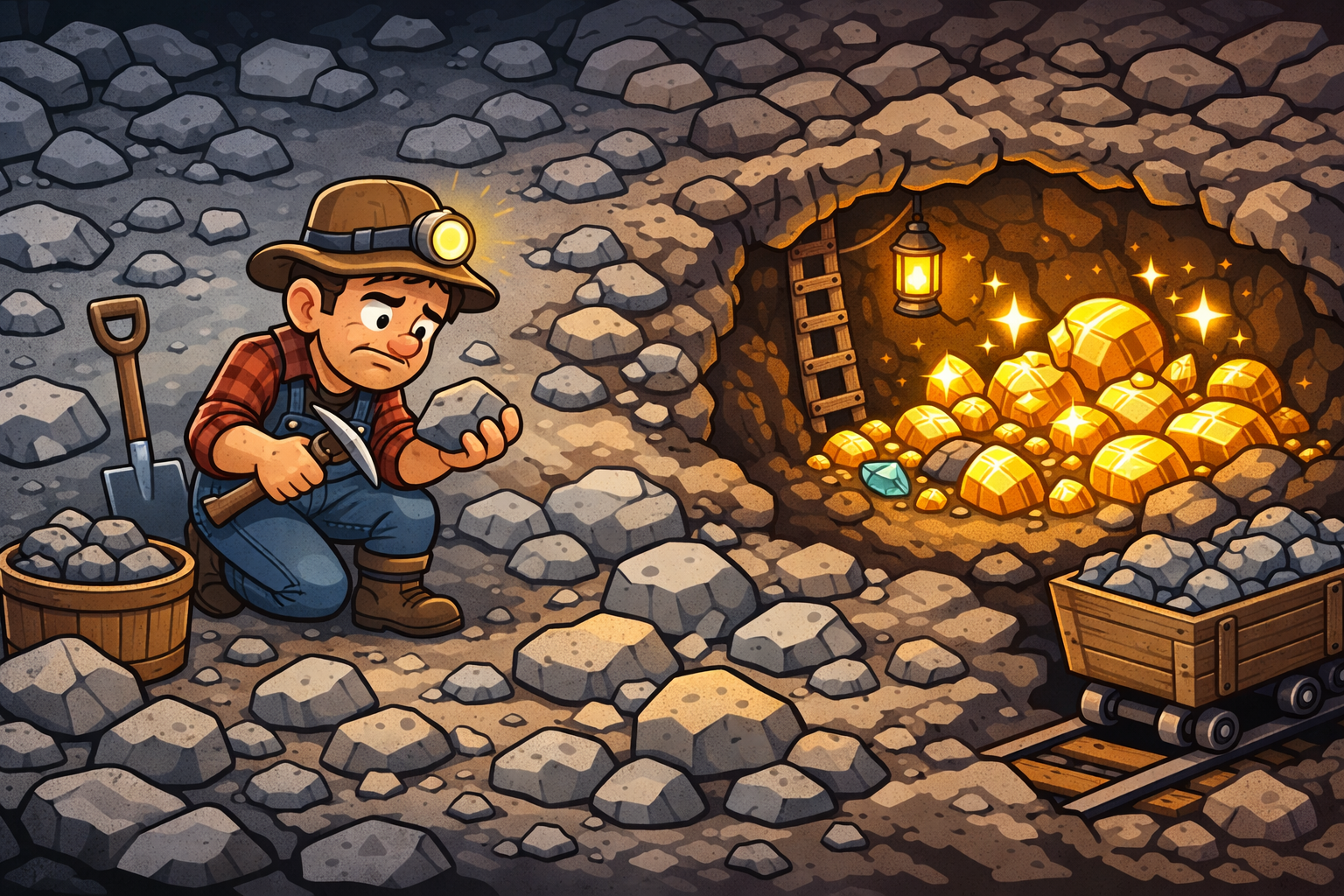
Partner Readiness Scoring: Stop Guessing Which Partners Are Worth Your Investment
Table of Contents
The Problem with Partner Investment Guesswork
What Is Partner Readiness Scoring?
Core Components of Effective Partner Scoring
Capability Assessment
Engagement Metrics
Market Alignment
Revenue Potential
Building Your Partner Readiness Framework
Step 1: Define Your Scoring Criteria
Step 2: Weight Your Variables
Step 3: Set Activation Thresholds
Measuring Success: KPIs That Matter
Common Scoring Mistakes to Avoid
Advanced Scoring Strategies
FAQs
Conclusion
You have 347 partners in your ecosystem. Twelve are actively driving revenue. The rest? Radio silence.
This isn't a partner quantity problem. It's a partner investment problem. You're spreading time, resources, and attention across partners who aren't ready, capable, or worth the effort.
Most partnership leaders operate on gut instinct when deciding where to invest. They chase the biggest names, the loudest voices, or whoever responded to their last email. Meanwhile, high-potential partners sit dormant because there's no systematic way to identify and prioritize them.
Partner readiness scoring changes this dynamic. Instead of guessing which partners deserve your attention, you get data-driven clarity on who's ready to drive revenue and who's wasting your time.
The Problem with Partner Investment Guesswork
Your partner program isn't failing because you lack partners. It's failing because you can't see which partners are worth investing in.
Traditional partner management treats all partners equally. Everyone gets the same onboarding, the same training, the same level of attention. This approach ignores a fundamental truth: not all partners are created equal, and they certainly don't all deserve equal investment.
Consider the typical scenario. You have a list of 200+ partners. Some signed up years ago and never engaged. Others completed training but haven't closed a single deal. A few are actively selling but need more support to scale. And buried somewhere in that list are dormant partners with real revenue potential who just need the right activation approach.
Without a scoring system, you treat them all the same. You send mass emails, host generic webinars, and wonder why partner-sourced revenue stays flat.
The cost of this approach is measurable. Every hour spent on unready partners is an hour not invested in partners who could actually drive results. Every resource allocated to dormant relationships is a resource not directed toward revenue-generating opportunities.
What Is Partner Readiness Scoring?
Partner readiness scoring is a systematic method for evaluating and ranking partners based on their ability and willingness to drive revenue for your business. It moves you from gut-based partner management to data-driven investment decisions.
A proper scoring system answers three critical questions:
Which partners are ready? They have the capability, resources, and market position to sell your solution effectively.
Which partners are willing? They're actively engaged, responsive to communication, and committed to the partnership.
Which partners are worth it? The revenue potential justifies the investment required to activate and support them.
The scoring process evaluates partners across multiple dimensions, assigns numerical values to each factor, and produces a composite score that indicates investment priority. High-scoring partners get focused attention and resources. Low-scoring partners get minimal investment or removal from active programs.
This isn't about ranking partners for ranking's sake. It's about directing limited partnership resources toward the relationships most likely to generate measurable revenue impact.
Core Components of Effective Partner Scoring
Capability Assessment
Partner capability measures their fundamental ability to sell your solution. This includes technical competence, sales resources, and market credibility.
Technical Competence: Can they demonstrate your product effectively? Do they understand the use cases, value proposition, and competitive positioning? Partners who can't articulate your solution's value won't close deals.
Sales Resources: Do they have dedicated salespeople? What's their average deal size and sales cycle? Partners without adequate sales capacity can't scale revenue regardless of their enthusiasm.
Market Credibility: Are they established in your target market? Do they have existing customer relationships and industry reputation? New or unknown partners face higher barriers to customer trust.
Training Completion: Have they completed your partner certification program? While training doesn't guarantee success, it indicates commitment and baseline competence.
Engagement Metrics
Engagement measures a partner's active participation in the relationship. High engagement correlates with revenue potential because engaged partners invest time and resources in your partnership.
Communication Frequency: How often do they respond to emails, join calls, or initiate contact? Responsive partners are easier to work with and more likely to act on opportunities.
Event Participation: Do they attend your partner events, webinars, and training sessions? Active participation indicates genuine interest in growing the partnership.
Content Utilization: Are they downloading sales materials, using your partner portal, or requesting marketing assets? Content usage shows they're actively selling your solution.
Pipeline Activity: Are they registering deals, submitting leads, or providing sales forecasts? Pipeline activity is the strongest predictor of future revenue.
Market Alignment
Market alignment evaluates how well a partner's customer base, geographic focus, and go-to-market strategy match your ideal customer profile.
Customer Overlap: Do their existing customers fit your target market? Partners selling to your ideal customers have shorter sales cycles and higher close rates.
Geographic Coverage: Are they active in markets where you want to grow? Geographic alignment reduces market development costs and accelerates expansion.
Solution Complementarity: Does your solution integrate well with their existing offerings? Complementary solutions are easier to sell and create more value for customers.
Competitive Conflicts: Do they sell competing solutions? Partners with competitive conflicts face internal resistance and divided loyalty.
Revenue Potential
Revenue potential estimates the financial opportunity a partner represents based on their market size, deal capacity, and growth trajectory.
Market Size: How large is their addressable market for your solution? Bigger markets create more opportunities for revenue growth.
Historical Performance: What's their track record with similar partnerships? Past performance indicates future potential.
Deal Size Capacity: What's their average deal size and sales velocity? Partners who close larger deals faster generate more revenue per investment dollar.
Growth Trajectory: Is their business growing or declining? Growing partners have more opportunities to sell your solution.
Building Your Partner Readiness Framework
Step 1: Define Your Scoring Criteria
Start by identifying the specific factors that predict partner success in your ecosystem. These criteria should be measurable, relevant to revenue outcomes, and aligned with your business objectives.
Create a comprehensive list of evaluation factors across the four core components. For each factor, define what good, average, and poor performance looks like. Be specific about measurement methods and data sources.
Example Criteria Framework:
Technical competence: Certification completion, demo quality scores
Sales resources: Number of dedicated reps, average deal size
Engagement: Email response rate, event attendance, portal usage
Market alignment: Customer overlap percentage, geographic match
Revenue potential: Market size, historical performance, growth rate
Step 2: Weight Your Variables
Not all scoring factors carry equal importance. Weight each variable based on its correlation with actual partner revenue performance.
Analyze your top-performing partners to identify which factors most strongly predict success. Revenue-generating partners typically score high on engagement and market alignment, while capability factors may be less predictive than expected.
Suggested Weighting Approach:
Engagement metrics: 35% (strongest predictor of near-term revenue)
Revenue potential: 30% (indicates long-term opportunity size)
Market alignment: 25% (affects deal velocity and close rates)
Capability assessment: 10% (baseline requirement, not differentiator)
Adjust these weights based on your specific market dynamics and partner program maturity.
Step 3: Set Activation Thresholds
Define score ranges that trigger specific actions and investment levels. Create clear guidelines for how partnership teams should respond to different score categories.
Tier 1 (80-100 points): High Investment
Dedicated partner manager assignment
Custom marketing campaigns and sales support
Priority access to product roadmap and beta programs
Quarterly business reviews and strategic planning
Tier 2 (60-79 points): Moderate Investment
Shared partner manager coverage
Standard marketing support and training programs
Regular check-ins and performance monitoring
Opportunity for tier advancement with improved performance
Tier 3 (40-59 points): Minimal Investment
Self-service resources and automated communications
Basic training and certification programs
Quarterly performance reviews
Focus on identifying improvement opportunities
Tier 4 (Below 40 points): Inactive
Minimal communication and resource allocation
Annual review for potential reactivation
Consider program removal if no improvement
Measuring Success: KPIs That Matter
Partner readiness scoring only works if it drives measurable business outcomes. Track these key performance indicators to validate your scoring system's effectiveness:
Partner-Sourced Revenue Growth: The ultimate measure of scoring success. High-scoring partners should generate more revenue than low-scoring partners.
Investment ROI: Calculate the return on investment for each partner tier. Tier 1 partners should generate significantly higher ROI than lower tiers.
Partner Activation Rate: Measure how many dormant partners move to active status after scoring-based interventions. Effective scoring identifies and activates previously overlooked opportunities.
Score Accuracy: Track how well initial scores predict actual partner performance over time. Continuously refine your scoring model based on real outcomes.
Resource Allocation Efficiency: Monitor how scoring changes your team's time allocation. More time should shift toward high-scoring partners with measurable results.
Common Scoring Mistakes to Avoid
Over-Weighting Capability: Many organizations focus too heavily on training completion and certifications while ignoring engagement signals. A certified partner who doesn't respond to emails won't drive revenue.
Ignoring Negative Indicators: Don't just score positive attributes. Account for red flags like competitive conflicts, poor communication, or declining business performance.
Static Scoring: Partner readiness changes over time. Update scores regularly based on new data and changing business conditions.
Complexity Overload: Avoid scoring systems with too many variables or complex calculations. Simple, actionable frameworks work better than sophisticated models that teams can't understand or implement.
Scoring Without Action: Creating scores without defined response protocols wastes effort. Every score range should trigger specific actions and investment decisions.
Advanced Scoring Strategies
Predictive Modeling: Use historical data to build predictive models that identify partners likely to become high performers before they show obvious success signals.
Behavioral Scoring: Track partner behavior patterns beyond basic engagement metrics. Monitor deal registration timing, support ticket patterns, and sales cycle characteristics.
Market-Specific Scoring: Adjust scoring criteria for different geographic markets or industry verticals. What predicts success in enterprise markets may not apply to SMB segments.
Competitive Intelligence: Factor in competitive dynamics when scoring partners. Partners in highly competitive markets may need different support strategies than those in blue ocean territories.
Dynamic Weighting: Adjust scoring weights based on market conditions, seasonal factors, or business priorities. Q4 revenue pushes might temporarily increase the weight of pipeline activity scores.
Partnership leaders using systematic readiness scoring report 40-60% improvements in partner-sourced revenue within 12 months. The key is consistent application and continuous refinement based on actual results.
Tools like PRTNRd's prtnrIQ make partner readiness scoring practical at scale. Instead of manually tracking dozens of variables across hundreds of partners, you get automated scoring that identifies investment priorities and activation opportunities.
FAQs
How often should I update partner readiness scores?
Update scores monthly for active partners and quarterly for dormant partners. More frequent updates help you catch engagement changes quickly, while less active partners don't require constant monitoring.
What's the minimum score threshold for continued partnership?
Partners scoring below 30 for three consecutive quarters should be considered for program removal. However, factor in market potential and relationship history before making final decisions.
How do I handle partners who score high on capability but low on engagement?
These partners represent activation opportunities. Implement targeted re-engagement campaigns focusing on their specific market position and capabilities. If engagement doesn't improve within 90 days, reduce investment levels.
Should I share readiness scores with partners?
Share general performance feedback but not specific numerical scores. Focus conversations on improvement areas and support opportunities rather than ranking positions.
How do I score new partners with limited data?
Start with capability and market alignment factors, then add engagement and revenue metrics as data becomes available. New partners should receive moderate investment until their true potential becomes clear.
What if my top-scoring partners aren't generating expected revenue?
Review your scoring criteria and weights. You may be over-emphasizing factors that don't actually predict revenue success. Analyze your highest-revenue partners to identify missing variables.
How do I prevent gaming of the scoring system?
Focus on outcome-based metrics rather than activity-based ones. Partners can artificially inflate engagement scores, but they can't fake actual revenue results or customer success metrics.
Conclusion
Partner readiness scoring transforms partnership management from guesswork into strategic investment decisions. Instead of spreading resources equally across all partners, you direct attention and support toward relationships most likely to drive measurable revenue growth.
The framework requires upfront effort to define criteria, set weights, and establish response protocols. But the payoff comes quickly. Partnership teams report significant improvements in partner-sourced revenue, resource allocation efficiency, and overall program ROI.
Your best revenue opportunities already exist in your partner ecosystem. You just need the right scoring system to identify and activate them.
Ready to stop guessing which partners deserve your investment? Learn more at getprtnrd.com.

What Vendors Get Wrong About Partner Readiness (And Why It Impacts Partner-Led Revenue)
Salesforce’s Shift Signals a Broader Change in Partner Strategy
Salesforce’s recent partner program changes—shifting from certifications and tier status to verified customer outcomes—reflect a broader shift in how enterprise ecosystems define partner value.
For years, partner programs have measured readiness through:
Certifications and credentials
Program tiers and badges
Training and enablement completion
However, these signals do not reliably indicate whether a partner can contribute to pipeline, influence deal outcomes, or support partner-led revenue growth.
As partner ecosystems evolve, vendors are being forced to answer a more critical question:
What actually makes a partner commercially ready?
The Problem: Traditional Partner Readiness Metrics Don’t Drive Revenue
Most partner programs define “partner readiness” based on activity and participation, not performance.
Common readiness metrics include:
Certification counts
Enablement completion rates
Partner portal engagement
Program progression
While these metrics are easy to track, they do not answer the core business question:
Can this partner help generate pipeline or close deals?
This disconnect leads to a familiar pattern across enterprise SaaS ecosystems:
A small percentage of partners drive the majority of partner-sourced and partner-influenced revenue
The broader partner base remains underutilized
Vendors struggle to scale partner-led growth despite heavy investment in enablement
This is not a partner supply problem.
It is a partner readiness definition problem.
Two Definitions of Partner Readiness: Ecosystem vs Sales
One of the biggest challenges in partner strategy is the misalignment between partner teams and sales teams.
Partner Teams Measure:
Certifications and credentials
Enablement and training completion
Program participation and engagement
Sales Teams Evaluate:
Ability to support deal execution
Understanding of the buyer and use case
Impact on deal velocity and win rates
These two perspectives rarely align.
As a result:
Partners may be considered “ready” within the ecosystem
But are not trusted or engaged by sales teams
This gap is one of the primary reasons partner programs fail to deliver consistent revenue impact.
What Is GTM Readiness? A Better Framework for Partner Evaluation
To drive partner-led revenue, organizations must shift from activity-based readiness to GTM (Go-To-Market) readiness.
GTM readiness focuses on whether a partner can actively participate in a sales motion.
A commercially ready partner demonstrates four capabilities:
1. Clear Use Case and Positioning
The partner has a defined offering, target customer profile (ICP), and business problem they solve.
2. Sales Motion Alignment
The partner understands how to engage in a deal, including when to enter, how to position, and how to support the sales cycle.
3. Delivery Credibility
The partner can deliver what they sell, with proof points such as case studies, references, or repeatable outcomes.
4. Business-Level Communication
The partner can communicate value in terms of business outcomes—not just product features.
Most partners are not missing all of these capabilities.
They are missing one or two critical components that prevent them from being usable in a live sales environment.
Why Outcome-Based Partner Programs Will Expose Readiness Gaps
The shift toward outcome-based partner programs—as seen with Salesforce—will accelerate pressure on vendors to rethink how they evaluate partners.
Outcome-based models require:
Measurable customer impact
Repeatable success patterns
Clear contribution to revenue
However, most organizations lack the visibility to determine:
Which partners are close to producing outcomes
Which partners require targeted enablement
Which partners are unlikely to contribute
Without this visibility, vendors default to over-investing in top-performing partners while ignoring the broader ecosystem.
The Revenue Impact of Misdefined Partner Readiness
Misaligned readiness definitions create significant revenue inefficiencies:
Underutilized mid-tier partners with high potential
Over-reliance on a small group of top partners
Inefficient partner enablement investments
Missed opportunities for partner-sourced pipeline
This is especially critical in enterprise SaaS ecosystems, where co-sell motions and partner-led growth strategies are increasingly central to revenue expansion.
The Next Evolution: Partner Intelligence and Readiness Scoring
To scale partner-led revenue, vendors need a more advanced approach to partner evaluation.
This includes:
Partner readiness scoring based on GTM capability
Identification of high-potential, underutilized partners
Targeted enablement based on readiness gaps
Alignment between partner teams and sales teams
This is the foundation of partner intelligence platforms like prtnrIQ, which are designed to:
Evaluate partner GTM readiness
Surface high-potential partners within large ecosystems
Provide actionable insights for partner activation and development
Enable scalable partner ecosystem management
As ecosystems grow, manual partner management models become insufficient.
Data-driven partner intelligence will become a core requirement for ecosystem strategy.
Conclusion: Redefining Partner Readiness for Scalable Growth
The definition of partner readiness is changing.
Certifications, tiers, and enablement activity are no longer sufficient indicators of value.
The future of partner ecosystems will be defined by:
Commercial readiness
Sales alignment
Measurable contribution to revenue
Organizations that adapt will be able to:
Activate a broader portion of their partner ecosystem
Scale partner-led revenue more effectively
Reduce dependency on a small set of top partners
Those that don’t will continue to invest in partner programs that look strong on paper—but fail to translate into meaningful business impact.

PAMs Aren’t the Bottleneck. The Model Is.
The Problem in Modern Partner Ecosystems
Across enterprise SaaS ecosystems, the same issue shows up:
Partner activation is low
Partner-sourced pipeline is concentrated
Mid-tier partners are underutilized
This is often framed as a Partner Manager (PAM) execution problem.
It’s not.
At PRTNRd, we consistently see that the real constraint in partner-led growth is the partner ecosystem operating model itself—not the people managing it.
Why Most Partner Management Models Don’t Scale
Most partner programs follow the same structure:
A small percentage of partners drive the majority of revenue
The remaining partners contribute little or no pipeline
So organizations respond by:
Prioritizing top partners
Aligning closely with proven system integrators (SIs)
Investing in partners already generating deals
This creates a reinforcing cycle:
Top partners receive more enablement and attention
Mid-tier and long-tail partners receive minimal support
Overall partner ecosystem growth stalls
This is not a failure of partner enablement.
It is a limitation of the traditional partner management model.
The Role of Partner Managers in This Model
Partner Managers are not the bottleneck in partner ecosystem performance.
They are responding to how success is measured:
Pipeline contribution
Deal acceleration
Sales alignment
Without access to structured partner intelligence, PAMs must rely on:
Existing relationships
Historical performance
Active deal flow
This leads to predictable outcomes:
Over-investment in top-performing partners
Underdevelopment of emerging partners
Limited visibility into which partners could drive future revenue
This is a structural issue—not an execution issue.
What a Scalable Partner Ecosystem Model Requires
To unlock partner-led growth at scale, organizations need to move beyond relationship-based partner management.
A modern partner ecosystem strategy requires:
Partner readiness scoring
Identifying which partners have real go-to-market (GTM) potentialGTM gap analysis
Understanding where partners are blocked (positioning, messaging, sales motion)Portfolio-level prioritization
Allocating resources based on potential—not just past performanceScalable partner enablement systems
Supporting partner development without requiring constant PAM involvement
This is the shift from:
Partner management → Partner intelligence and orchestration
This is also the role prtnrIQ is designed to play—bringing structured partner intelligence, readiness scoring, and GTM insight into enterprise partner ecosystems.
Rethinking Partner-Led Growth
If your partner ecosystem is not scaling, the issue is not that your Partner Managers need to do more.
It’s that the current partner management model:
Concentrates effort on a small subset of partners
Lacks visibility into broader partner potential
Cannot scale across large enterprise ecosystems
At PRTNRd, we focus on helping organizations redesign their partner ecosystem strategy to:
Activate mid-tier partners
Increase partner-sourced pipeline
Build scalable partner-led growth models
Because sustainable ecosystem growth does not come from managing more partners.
It comes from managing them differently.

Ecosystem Enablement Without Accountability Is Just Content Marketing
Why Most Partner Enablement Programs Fail to Activate Ecosystems
Many enterprise SaaS companies invest heavily in partner enablement. They build certification programs, host webinars, publish partner playbooks, and maintain extensive partner portals designed to help partners learn their solutions.
Despite this investment, most ecosystems experience the same outcome:
A small group of partners drives the majority of revenue while the rest of the ecosystem remains largely inactive.
This happens because most partner ecosystem enablement programs focus on distributing information rather than changing partner behavior.
When enablement provides content without defining commercial expectations, it becomes indistinguishable from marketing.
In other words: Ecosystem enablement without accountability is simply content publishing — not partner activation.
The difference between effective and ineffective enablement is not the amount of material produced. It is whether the program creates clear behavioral expectations for how partners should engage in the market.
The Illusion of Partner Enablement
Many organizations measure the success of partner enablement through activity metrics.
Typical indicators include:
Number of partners attending enablement sessions
Certifications completed
Playbooks downloaded
Engagement with partner portal content
These metrics suggest that enablement programs are working.
However, they rarely correlate with the outcomes that matter inside the field: whether partners are actively selling with the vendor.
A partner can:
Complete certification
Attend multiple enablement sessions
Download every partner playbook
List the solution on their website
And still never introduce the solution in a customer conversation.
From a program perspective, enablement appears successful. From a sales perspective, nothing has changed.
As a result, account executives continue relying on the same partners they already trust, while the rest of the ecosystem remains inactive.
Why Partner Enablement Often Fails to Change Behavior
Most partner enablement initiatives are designed around knowledge transfer.
The assumption is that partners will sell more effectively if they understand the solution better.
In reality, partners rarely struggle with understanding the product itself. The larger challenge is integrating the vendor’s solution into their existing sales motion.
Partners must determine how the solution fits into:
Their existing customer problems
Their delivery capabilities
Their account relationships
Their internal incentives
Without guidance on how the vendor fits into those elements, enablement remains theoretical.
Partners may understand the product technically but still lack clarity on:
When to introduce it in a customer conversation
Which customers are the best fit
How it fits into a broader transformation narrative
How to coordinate the motion with the vendor’s sales teams
This gap between knowledge and commercial motion is where most partner enablement programs break down.
The Mid-Tier Partner Opportunity Most Ecosystems Miss
The limitations of traditional enablement become especially visible among mid-tier partners.
Top strategic partners typically require less enablement support. They already operate mature go-to-market organizations, alliance teams, and structured sales processes capable of integrating new vendor solutions.
Mid-tier partners often have strong growth potential but lack the operational structure needed to activate it.
Many of these partners already possess key ingredients for success:
Existing customer relationships
Industry expertise
Delivery capabilities aligned to the vendor’s solution
A desire to expand their partnership footprint
What they frequently lack is a repeatable commercial motion for how to position the vendor’s solution with customers.
Traditional partner enablement rarely solves this problem because it focuses on education rather than motion design.
Mid-tier partners do not need more product training. They need support translating partner enablement into real customer engagement.
What Effective Ecosystem Enablement Looks Like
Effective partner ecosystem enablement focuses on behavioral activation rather than content distribution.
Instead of measuring how many partners consume enablement material, successful programs define specific actions partners should take after enablement.
For example, a partner activation program might establish clear milestones:
Within the first 30 days
Define a use case aligned to a specific customer problem
Identify the ideal customer profile for that use case
Develop joint positioning with the vendor
Within 60 days
Conduct joint customer conversations
Deliver a partner-led demonstration or workshop
Identify target accounts aligned to the solution
Within 90 days
Launch a structured co-sell motion with vendor sales teams
Participate in joint pipeline reviews
Identify opportunities for expansion within active accounts
When enablement is structured around these types of behavioral expectations, partners move from learning about the solution to selling with the vendor.
Accountability Is the Missing Layer in Most Ecosystems
The final factor that determines whether partner enablement succeeds is accountability. Historically, partner programs have been designed to remain flexible and optional. Vendors provide enablement resources, and partners choose how deeply they engage. However, modern enterprise ecosystems are too large for this model to scale effectively.
Successful ecosystems treat enablement less like optional training and more like a structured pathway to deeper collaboration.
Partners that actively participate in enablement and demonstrate progress gain access to additional opportunities:
Introductions to vendor sales teams
Joint pipeline collaboration
Marketing investment
Strategic account alignment
Partners that do not engage remain part of the ecosystem but without those additional advantages. This structure creates clarity across the ecosystem. Enablement is no longer simply content the vendor publishes. It becomes a pathway partners follow to activate real market collaboration. And when partner behavior begins to change, the largest untapped portion of the ecosystem — the mid-tier — finally begins to move.
Why Partner Enablement Must Evolve
Enterprise ecosystems are expanding rapidly, often including hundreds or thousands of partners. Publishing more enablement content will not activate these ecosystems.
The vendors that succeed will treat partner enablement as a commercial activation system rather than a content distribution program.
Because ecosystems do not scale on information. They scale on behavior.
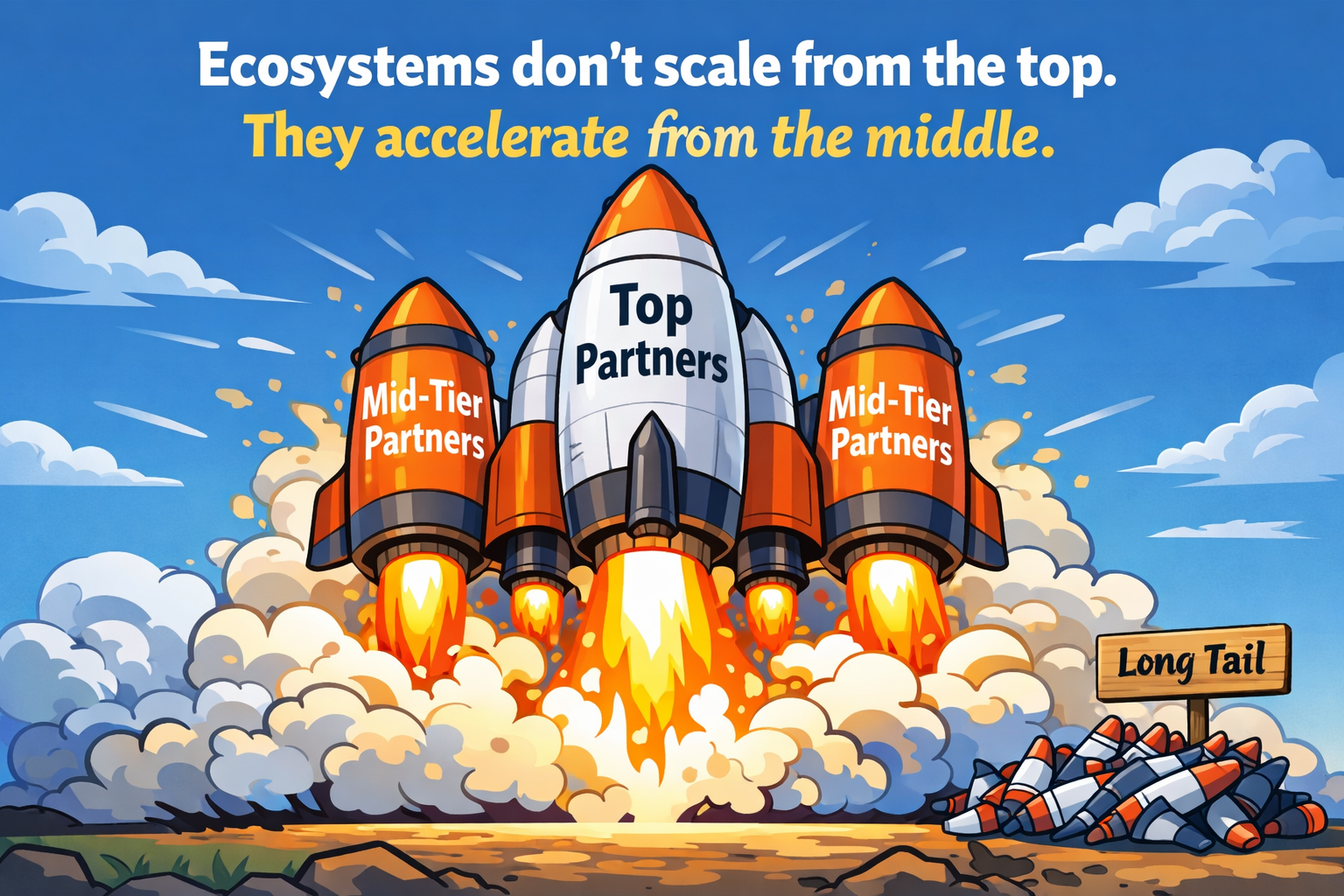
Why Mid-Tier Partners Are the Real Growth Engine of Partner Ecosystems
Most partner ecosystem strategies concentrate the majority of their resources on a small set of top-tier partners.
These partners often produce the largest share of partner-influenced revenue, maintain executive relationships with the vendor, and have established co-sell motions with the vendor’s field sales teams.
Focusing on these partners provides stability.
However, it rarely produces meaningful ecosystem growth.
Understanding the Three Layers of a Partner Ecosystem
Most mature SaaS partner ecosystems naturally organize into three distinct tiers:
• Top-tier partners
• Mid-tier partners
• Long-tail partners
Top-tier partners drive predictable revenue and maintain deep alignment with the vendor’s go-to-market strategy.
Long-tail partners typically participate sporadically. They may register deals or support implementations but rarely contribute consistent partner-sourced pipeline.
Between these two layers sits the most strategically important segment of the ecosystem.
The mid-tier.
Why Mid-Tier Partners Represent the Largest Untapped Opportunity
Mid-tier partners frequently already possess the operational capability required for partner-led sales.
Many of these organizations have:
• Proven customer implementations
• Certified delivery teams
• Industry specialization
• Emerging solution accelerators
• Experience working inside the vendor’s technology stack
What they often lack is not capability.
It is integration into the vendor’s go-to-market motion.
Without clear joint use cases, defined co-sell processes, and visibility within the vendor’s field sales organization, these partners remain underutilized despite strong delivery capabilities.
Where Partner Ecosystem Growth Often Breaks Down
This gap between partner capability and partner activation is where ecosystem growth frequently stalls.
Vendors invest heavily in onboarding partners, building partner portals, and producing enablement content. Yet many of these efforts fail to translate into repeatable partner-led revenue.
The reason is structural.
Partners cannot participate in a sales motion that does not exist.
Without defined joint value propositions, aligned account targeting, and consistent collaboration with field sellers, capable partners remain outside the vendor’s active sales cycle.
In many ecosystems, this leaves the majority of potential ecosystem capacity untapped.
Activating the Middle of the Ecosystem
When vendors focus on activating mid-tier partners, the results can be significant.
Mid-tier partners often represent the next wave of specialization across areas such as:
• Industry-specific solutions
• Regional implementation expertise
• Emerging technology capabilities
• New service delivery models
Because these partners are still building their ecosystem presence, their growth trajectory can be substantially higher than that of already-established partners whose sales motions are mature.
Organizations that invest in mid-tier partner activation frequently see stronger ecosystem expansion than those focused exclusively on managing their largest partners.
How Ecosystem Leaders Unlock Mid-Tier Partner Growth
For ecosystem leaders focused on scaling partner-led revenue, the priority should extend beyond managing strategic partners.
It should include identifying and activating the next generation of them.
This typically requires three structural elements:
• Clearly defined joint use cases between vendor and partner
• Sales enablement that prepares partners to participate in real co-sell motions
• Consistent collaboration between partners and the vendor’s field sellers
When these elements are present, mid-tier partners often become some of the most productive contributors to partner-sourced pipeline.
Why the Future of Partner Ecosystem Growth Sits in the Middle
The next generation of top partners rarely appears suddenly.
They emerge from the capable middle of the ecosystem.
Organizations that systematically identify partners with strong delivery capabilities, align them with real customer use cases, and integrate them into repeatable co-sell motions unlock one of the most reliable sources of ecosystem expansion.
This is a core principle behind the ecosystem operating models developed at PRTNRd and the partner readiness insights generated through prtnrIQ, which focus on identifying partners capable of participating in scalable go-to-market motions.
Final Thoughts
The future growth of a partner ecosystem rarely comes from the partners already at the top.
It comes from the capable partners in the middle who are ready to scale.
Vendors that recognize and activate this segment early build ecosystems that grow faster, diversify solution delivery, and generate more durable partner-led revenue.

Stop Asking Partners for Pipeline. Ask Them for Proof.
In growth-stage SaaS companies, partner pipeline is easy to report.
Influenced revenue, deal registrations, and partner-sourced opportunities appear neatly in dashboards and quarterly business reviews. These metrics are frequently used to demonstrate ecosystem growth and partner program health.
But inside the field organization, seller behavior tells the real story.
If sales teams are not consistently engaging partners early in the sales cycle, the problem is rarely pipeline volume.
It is motion credibility.
Why Seller Adoption Determines the Success of Partner Programs
For CROs, revenue leaders, and ecosystem teams, seller adoption is the hidden friction inside many SaaS partner programs.
Field sellers operate under quota pressure and strict stage progression requirements. Every resource introduced into a deal is evaluated through the lens of execution risk.
When a partner joins an opportunity, the sales rep is asking a series of practical questions:
• Can this partner run effective discovery with the customer?
• Do they understand the ideal customer profile (ICP)?
• Is the use case repeatable across similar accounts?
• Is there a clear 30–60 day path to customer value?
• Will involving this partner accelerate the deal—or slow it down?
When those answers are unclear, sellers revert to what they trust.
They either rely on the same small group of familiar partners or delay partner involvement until late-stage implementation.
Pipeline Metrics Often Hide Execution Gaps
Many ecosystem dashboards emphasize partner activity metrics:
• Deal registrations
• Partner-sourced pipeline
• Influenced revenue
• Number of active partners
While these metrics are important, they are lagging indicators of ecosystem performance.
Execution discipline is the leading indicator.
A partner ecosystem can generate significant pipeline activity while still failing to produce consistent seller adoption.
The difference lies in motion quality.
What Real Partner Qualification Looks Like
Strong partner-led sales motions require the same level of inspection applied to direct sales teams.
Effective partner qualification focuses on operational proof, not activity volume.
Key signals include:
• Case depth within a clearly defined ICP
• Trigger events that create urgency for the buyer
• Repeatable use cases tied to specific customer problems
• Documented discovery frameworks used by the partner
• Defined handoffs between vendor sellers and partner teams
• Consistent deal anatomy (ACV range, sales cycle, and win pattern)
When these elements are present, sellers gain confidence that partner involvement will strengthen the opportunity rather than introduce risk.
Without this level of rigor, partner adoption initiatives often stall regardless of pipeline volume.
Why Expanding the Partner Roster Doesn’t Solve the Problem
Many organizations respond to slow ecosystem growth by increasing partner recruitment or launching new enablement programs.
However, expanding the number of partners does not address the underlying issue if execution credibility is missing.
Field sellers rarely engage partners simply because they are listed in a portal or included in enablement campaigns.
They engage partners when those partners consistently help them win deals.
That credibility is built through disciplined partner qualification and repeatable co-sell motions.
Building Trust in Partner-Led Sales Motions
If partners are extensions of the sales organization, they must be evaluated with the same rigor as direct sellers.
That means validating motion quality before exposing partners to the field.
Organizations that succeed with partner-led revenue focus on:
• Repeatable use cases aligned to customer demand
• Structured collaboration between sellers and partners
• Clear sales engagement models
• Consistent partner readiness standards
This level of operational discipline transforms partners from occasional implementation support into trusted contributors inside live sales cycles.
How PRTNRd Helps SaaS Companies Strengthen Partner-Led Sales
At PRTNRd, we work with Series D–E and enterprise SaaS companies to strengthen partner-led revenue motions and improve seller adoption inside partner ecosystems.
Our work focuses on operational execution, including:
• Partner activation programs that prepare partners for real co-sell engagement
• Seller adoption campaigns that build confidence between field sellers and partners
• Structured partner qualification and readiness frameworks
• Repeatable partner-led sales motions aligned to customer demand
As these systems mature, partner pipeline begins to grow more predictably.
Final Thoughts
Partner pipeline is the result.
Proof is the prerequisite.
Ecosystems that prioritize execution discipline—through partner readiness, motion design, and seller adoption—build partner programs that consistently produce revenue rather than simply reporting activity.

Visibility Is a Terrible Proxy for Partner Value
Executive attention, MDF, co-sell alignment, roadmap access — these are finite assets. In theory, they should flow toward partners who compound revenue over time. In practice, they flow toward partners who are most visible.
Most partner ecosystems allocate resources based on visibility.
Executive attention, market development funds (MDF), co-sell alignment, and product roadmap access are finite assets inside any SaaS partner program.
In theory, these resources should flow toward partners who consistently compound partner-led revenue over time.
In practice, they often flow toward partners who are simply the most visible.
Why Visibility Becomes the Default Signal
Visibility is easy to defend internally.
It shows up in dashboards.
It produces screenshots.
It creates the perception that the partner ecosystem is active and expanding.
For ecosystem leaders trying to demonstrate momentum to executive teams, visible activity feels like progress.
But visibility is not the same as performance.
And when partner ecosystems confuse activity with impact, strategic resources begin to flow toward the wrong partners.
How Ecosystems Misallocate Capital
When visibility becomes the dominant signal inside partner programs, ecosystem capital tends to concentrate around the partners who promote themselves most effectively.
These partners often receive:
• Disproportionate MDF allocation
• More executive attention and internal advocacy
• Preferential alignment with field sellers
• Early access to product roadmap discussions
Meanwhile, partners who quietly execute disciplined go-to-market motions often receive less attention.
These organizations may have:
• Clearly defined vertical strategies
• Repeatable sales motions aligned to the vendor’s ICP
• Strong delivery teams protecting the vendor’s brand
• Consistent deal expansion within customer accounts
Yet because they are not optimizing for internal visibility, their performance is frequently under-recognized.
Why This Distorts Ecosystem Growth
Over time, this dynamic creates structural distortion inside the partner ecosystem.
Attention scales quickly.
Performance does not automatically follow.
When ecosystem resources are allocated based on activity signals rather than execution quality, vendors amplify presence rather than revenue.
The loudest partners become more visible.
But the partners capable of producing durable partner-led growth often remain underdeveloped.
What High-Performing Ecosystems Measure Instead
Ecosystems that scale effectively shift their focus away from activity metrics and toward structural partner strength.
Instead of asking which partners are most visible, they evaluate deeper indicators of partner readiness and motion quality.
Key questions include:
• Does the partner have a clearly defined ideal customer profile (ICP)?
• Can their sellers independently position the joint value proposition?
• Are use cases repeatable across multiple customer accounts?
• Is delivery quality consistently protecting the vendor’s reputation?
• Are deals expanding within accounts rather than appearing as isolated opportunities?
These indicators require deeper assessment than simple activity metrics.
But they surface the partners who compound revenue over time.
Why Structural Alignment Matters for Partner-Led Revenue
Ecosystems are not neutral capital allocators.
They are shaped by the signals that leaders choose to prioritize.
If a partner program funds visibility, it will amplify presence.
If it funds structural alignment — repeatable use cases, disciplined co-sell motions, and strong delivery capability — it will scale performance.
This distinction becomes increasingly important as SaaS ecosystems mature and partner-led revenue becomes a larger share of overall growth.
How PRTNRd Evaluates Ecosystem Strength
At PRTNRd, we help enterprise SaaS companies evaluate partner ecosystem performance through deeper readiness signals rather than surface-level activity metrics.
Our ecosystem operating models focus on identifying partners who demonstrate:
• Clear go-to-market alignment
• Repeatable sales motions
• Strong delivery capability
• Durable expansion patterns inside customer accounts
These indicators reveal which partners are positioned to generate sustainable partner-led revenue.
They also highlight where ecosystem resources should be concentrated to accelerate growth.
Final Thoughts
Partner ecosystems are shaped by what leaders choose to measure.
If you continue funding visibility, you will amplify presence.
If you fund structural alignment, you will scale performance.
The difference determines whether your partner strategy plateaus — or compounds.

You Don’t Have a Partner Performance Problem. You Have a Signal Problem.
When partners fail to produce pipeline, the reaction inside most partner ecosystems is predictable.
They’re not focused.
They’re not serious.
They’re mid-tier for a reason.
The narrative quickly becomes about partner effort or partner capability.
But the reality is far less clear.
Most SaaS vendors have very limited visibility into what is actually happening inside a partner’s sales motion. Vendors only see activity once it enters their own systems — a deal registration, a sourced opportunity, a quarterly business review slide.
By the time those signals appear, the underlying motion has already either worked or failed.
There is no room left to diagnose it.
You are not measuring partner performance.
You are measuring residue.
What Most Partner Ecosystems Actually Track
Look at the metrics most partner programs rely on to evaluate ecosystem performance:
Revenue contribution
Influenced pipeline
Deal registrations
Certifications completed
Partner portal engagement
Event attendance
These metrics appear frequently in partner dashboards and ecosystem reports.
But they do not reveal whether a partner actually has a viable go-to-market motion.
They do not show whether a partner has a clear entry point into customer conversations, whether their sellers understand when to introduce your solution, or whether their target customer profile is even defined.
They reveal who is already succeeding.
They do not reveal who could succeed.
Why This Is a Signal Detection Problem
The real indicators of partner success appear earlier in the sales motion — long before pipeline appears in a CRM.
Those signals look very different from traditional partner metrics.
They include structural questions such as:
Can the partner clearly articulate who they sell to and why your solution belongs in that deal?
Do they have a defined first offer that consistently gets them into customer conversations?
Is there a predictable sales stage where your product enters the opportunity?
Are deals following a repeatable pattern, or are they accidental?
These are structural signals inside a partner-led sales motion.
They determine whether a partner is incubatable, scalable, or simply not ready.
Without visibility into these indicators, every partner looks roughly the same — until revenue appears for a few and not for the rest.
Why This Problem Compounds at Ecosystem Scale
This signal problem becomes even more pronounced in large SaaS ecosystems.
When vendors manage hundreds or thousands of partners, it becomes impossible to manually evaluate the quality of every partner’s go-to-market motion.
So organizations default to a familiar strategy.
They invest heavily in the top 10 percent of partners and describe it as focus.
Meanwhile, the long tail of the ecosystem becomes a write-off — not necessarily because those partners lack potential, but because the vendor lacks visibility into their motion quality.
Behavior Is the Leading Indicator of Partner Success
Partner pipeline is a lagging indicator.
Partner behavior is the leading one.
If ecosystem leaders cannot see how partners position, qualify, package, and progress deals, they cannot effectively manage partner performance.
They are reacting to outcomes rather than shaping them.
This is why many partner ecosystems feel unpredictable.
The variability is not random.
It is simply unmeasured.
The Next Evolution of Ecosystem Intelligence
The vendors who solve this problem will not simply hire larger partner teams or launch more enablement campaigns.
They will build better signal detection.
They will develop the ability to identify partners with scalable go-to-market motions before revenue appears — not after.
At PRTNRd, this shift toward earlier behavioral signals is central to how we evaluate partner readiness and ecosystem potential.
Through ecosystem operating models and emerging partner intelligence systems like prtnrIQ, vendors can begin identifying which partners are incubatable, scalable, or not yet ready long before traditional pipeline metrics appear.
Final Thoughts
Pipeline is the result.
Behavior is the signal.
The ecosystems that learn to detect those signals earlier will be the ones that scale partner-led revenue predictably — instead of waiting for success to appear after the fact.

Why Most Partner Enablement Fails Before the First Call
In small ecosystems, partner enablement tends to work well enough. A manageable number of partners, familiar sellers, and a narrow set of use cases make it easier to fill gaps through relationships. When something isn’t clear, a PAM steps in. When a deal stalls, context fills the void.
That dynamic doesn’t survive scale.
In smaller partner ecosystems, enablement often works well enough.
A limited number of partners, familiar sellers, and a narrow set of use cases make it easier to fill gaps through relationships. When something isn’t clear, a partner manager steps in. When a deal stalls, shared context fills the void.
This model works at small scale.
It rarely survives growth.
Why Partner Enablement Breaks at Ecosystem Scale
As SaaS partner ecosystems expand into the hundreds or thousands of partners, enablement becomes less about effort and more about design.
Most partner enablement programs were not built for a world where partners are expected to arrive deal-ready without hands-on guidance from partner managers.
In smaller ecosystems, context fills gaps.
At scale, context disappears.
Partners are left to interpret how product knowledge translates into real sales motion.
How Product Training Became a Substitute for Readiness
Over time, product enablement became the default proxy for partner readiness.
Product training is necessary. It ensures partners understand how the solution works, how it integrates with other technologies, and how it can be implemented.
But product knowledge alone does not prepare partners for partner-led sales.
Understanding what a product does does not teach partners:
When to engage during a sales cycle
How to position value in a live customer conversation
Which use cases convert reliably
How to earn early trust from a vendor’s field sellers
Partners may be certified.
But they are often unsure how to show up in real sales motion.
Where the Enablement Gap Appears
This gap becomes visible immediately—often before the first customer call ever happens.
Most partner ecosystems never explicitly enable partners on the realities of how deals are actually won.
There is little guidance around:
Typical deal shape and customer entry points
Where the partner should lead versus support
Which buyer problems create the strongest joint opportunities
When partners should introduce the vendor into the deal
How to reduce execution risk for the account executive
Partners are told what they can sell.
They are rarely shown how to sell it together.
Why the Problem Gets Worse at Scale
As ecosystems grow, enablement programs often optimize for consistency rather than usability.
Content becomes standardized.
Context gets stripped away.
Messaging becomes broad enough to apply across many partners and industries.
The result is predictable.
Partners are left to interpret how to apply what they learned across different sellers, deal types, and customer pressures.
Some partners adapt.
Most hesitate.
The Signals Partner Sales Teams Start to Send
When enablement stops short of helping partners sell, the field begins to surface subtle signals.
You start hearing the same patterns repeated across different teams:
“We need the right deal for them.”
“It works when the seller already has a relationship.”
“They’re great in delivery—getting them involved early is the hard part.”
These comments are often interpreted as partner quality issues.
In reality, they are signals that partner enablement stopped short of preparing partners for real sales motion.
The Shift from Product Enablement to Motion Clarity
Solving this problem does not require more enablement content.
It requires clearer sales motion design.
Effective partner enablement begins with understanding how deals are actually won and translating that into partner execution.
That includes defining:
Where partners fit within the sales cycle
When they should engage with the customer
How they add value early in the opportunity
Why field sellers should trust the introduction
When partners are enabled on the motion—not just the product—the first customer conversation becomes far more likely to happen.
How PRTNRd Approaches Partner Enablement
At PRTNRd, we help SaaS companies design partner enablement systems that prepare partners for real co-sell engagement rather than simply delivering product education.
Our work focuses on helping partners understand:
The customer problems that drive real opportunities
The joint value proposition between partner and vendor
The repeatable use cases that win deals
The sales motion where partner involvement adds value early
This approach ensures that partner readiness translates directly into partner-led revenue.
The Takeaway
In scaled partner ecosystems, enablement that stops at product knowledge is not neutral.
It is limiting.
When many partners struggle in similar ways, it is rarely an individual partner problem.
It is a signal that the system translating product value into partner execution is incomplete.
Strong ecosystems do not just train partners.
They prepare them to sell—together.

5 Ways Ecosystem Leaders Can Support Partner Go-To-Market Without Owning It
In small ecosystems, partner go-to-market (GTM) tends to sort itself out. A handful of partners, a few sellers who know each other, and limited use cases make coordination manageable. Gaps get patched through relationships. Early wins reinforce the idea that partners can figure it out.
That assumption breaks at scale.
Once ecosystems grow into the hundreds or thousands, partner GTM becomes less about effort and more about design. Partners aren’t failing—but the system around them isn’t built to help good intentions turn into repeatable outcomes. Below are five concrete ways ecosystem leaders can support partner GTM without taking ownership of every partner’s strategy.
In smaller partner ecosystems, partner go-to-market (GTM) often develops organically.
A manageable number of partners, familiar field sellers, and a narrow set of use cases make coordination easier. When something is unclear, partner managers step in. When a deal stalls, relationships and context fill the gap.
Early wins reinforce the idea that partners can figure it out.
That assumption breaks at scale.
Why Partner GTM Breaks in Large Ecosystems
As SaaS partner ecosystems grow into the hundreds or thousands of partners, partner go-to-market strategy becomes less about effort and more about system design.
Partners are not necessarily failing.
But the ecosystem around them is rarely designed to help good intentions translate into repeatable partner-led revenue.
Without clear motion design, partners are left to interpret how to position the vendor’s solution, when to engage sellers, and how to introduce the joint value proposition into real customer conversations.
That uncertainty slows ecosystem growth.
1. Define the GTM constraints, not just the opportunity
Most vendors communicate what partners can sell.
Few explain what partners should sell first.
Clear constraints help partners focus their go-to-market efforts around the motions the ecosystem is actually optimized to support right now.
Partners need clarity on signals such as:
Which buyers are most likely to convert
Which use cases sellers already recognize
Which industries or segments the field prioritizes
Which motions the vendor actively supports in co-sell deals
Narrow guidance increases focus and reduces noise for field sellers.
It also increases the probability that partner activity converts into real pipeline rather than scattered effort.
2. Package entry points that field sellers recognize
Partners struggle when their go-to-market approach begins with capabilities rather than customer problems.
Ecosystem leaders can help by codifying a small number of repeatable entry points that align with how internal sales teams already sell.
Effective entry points typically include:
Clear buyer problems tied to specific roles or industries
Trigger events that create urgency for the customer
A consistent first-conversation narrative
A defined path from discovery to early value
When partners sound familiar to the field organization, trust forms faster and co-sell friction drops.
3. Make partner readiness visible before pipeline appears
Partner pipeline is a lagging indicator.
By the time pipeline appears in CRM, the partner’s go-to-market motion has already succeeded or failed.
Mid-to-large ecosystems need earlier visibility into partner readiness signals such as:
Clarity of the partner’s ideal customer profile (ICP)
Strength and specificity of partner use cases
Consistency of the partner’s messaging
Early collaboration with field sellers
Seeing these signals earlier allows ecosystem teams to support partners before momentum stalls.
4. Reinforce behavior, not just deliver enablement
One-time partner training rarely changes how partners sell.
Behavior changes through repetition, feedback, and reinforcement.
Effective partner enablement systems create learning loops where:
Partners apply a defined motion in real opportunities
Ecosystem teams observe what works and what stalls
Feedback helps refine positioning and engagement timing
Successful patterns are reused across future deals
Enablement should evolve in response to partner behavior, not simply follow calendar-based training cycles.
5. Create a path from “capable” to “trusted”
Most partners do not need more enablement content.
They need credibility with field sellers.
Trust grows when partners consistently demonstrate value inside real deals.
Ecosystem leaders can accelerate this trust by:
Highlighting early customer wins involving partners
Clarifying how partners should show up in co-sell deals
Reinforcing what effective partner participation looks like
Aligning partner roles within the sales cycle
Trust is not built through partner portals.
It is built through consistent, visible execution inside the sales motion.
How PRTNRd Supports Partner Go-To-Market at Scale
At PRTNRd, we work with enterprise SaaS companies to design ecosystem systems that help partners develop repeatable go-to-market motions rather than relying on individual relationships.
This includes helping vendors:
Clarify partner entry points aligned to field sales priorities
Identify partners with scalable GTM readiness
Build repeatable partner-led sales motions
Reinforce co-sell behaviors that drive predictable pipeline
When ecosystem design supports partner execution, partner-led revenue becomes far more predictable.
The Takeaway
You do not need to own your partners’ go-to-market strategy.
But in scaled partner ecosystems, leaving partner GTM completely unsupported is not neutral.
When many partners struggle in similar ways, it is a signal that the system translating product value into partner execution is incomplete.
Strong ecosystems do not just attract partners.
They help the right partners show up focused, credible, and ready to win.
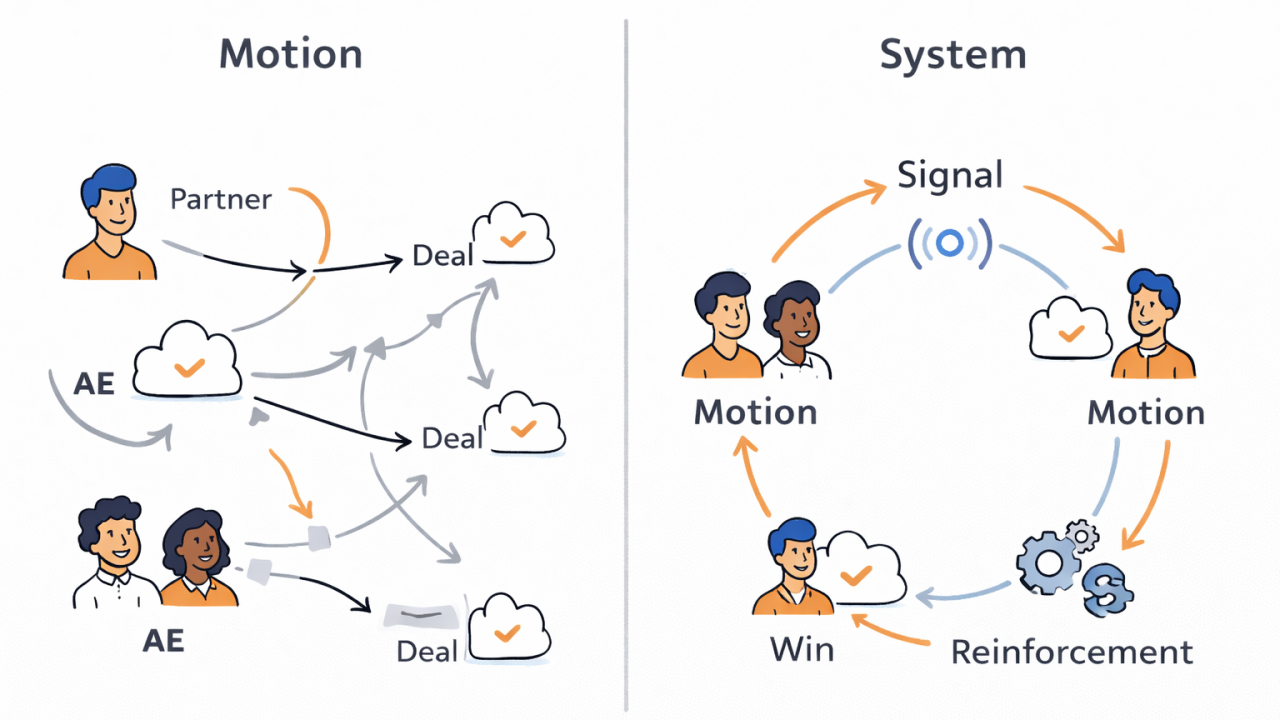
Why Partner-Led Growth Stalls — And What Scaled Ecosystems Do Differently
Most teams pursuing partner-led growth aren’t struggling to get started. They have partners they trust, deals they’ve closed together, and enough evidence to believe the model works. Early wins build confidence, shift internal perception, and justify continued investment.
The problem shows up later.
Success doesn’t compound the way leadership expects it to. The same outcomes don’t repeat across sellers, partners, or quarters. Momentum builds unevenly, stalls without a clear explanation, and becomes difficult to forecast. What once felt promising starts to feel fragile.
That’s usually when teams push harder—more partners, more enablement, more activity. What gets missed is that partner-led growth is being treated like a motion at the exact moment it requires a system.
Most teams pursuing partner-led growth are not struggling to get started.
They already have partners they trust, deals they have closed together, and enough early success to believe the model works. These early wins build confidence, shift internal perception, and justify further investment in the partner ecosystem.
The challenge appears later.
Success does not compound the way leadership expects. The same outcomes do not repeat across sellers, partners, or quarters. Momentum grows unevenly, stalls without a clear explanation, and becomes difficult to forecast.
What once felt promising begins to feel fragile.
That is usually when organizations push harder—adding more partners, launching more enablement, and increasing ecosystem activity.
What often goes unnoticed is that partner-led growth is still being treated like a motion at the exact moment it requires a system.
The Shift Most Partner Programs Don’t Realize They’ve Crossed
Partner-led growth works well when ecosystems are small.
A limited number of partners, a handful of sellers who know how to collaborate, and a narrow set of use cases make coordination manageable. Context travels informally. Sellers know which partners to call. Success feels intuitive.
Then the ecosystem expands.
Partner counts increase.
More sellers participate in partner deals.
Vertical priorities multiply.
Leadership begins asking for predictable partner pipeline.
At this point, partner-led growth stops responding primarily to effort and begins responding to design.
Organizations that miss this shift continue operating as if relationships and intuition will scale naturally.
They rarely do.
What works at small scale becomes inconsistent at medium scale and chaotic at large scale.
Why One-Off Co-Sell Wins Don’t Compound
Early partner wins are often used as proof that the partner-led revenue model works.
In isolation, they do.
The problem is that these wins rarely leave anything behind that helps the next deal succeed.
When teams look back, they often struggle to answer basic questions:
Why did this deal actually work?
What moved the opportunity forward?
Which elements of the motion mattered most?
Many early wins depend heavily on specific individuals, implicit collaboration patterns, and post-deal coordination.
Replication is attempted without understanding the underlying drivers.
These wins are not failures.
They are incomplete.
When success depends on who is involved instead of how the work is structured, variance grows faster than results.
Campaigns Create Activity. Systems Create Memory.
Many partner programs operate through recurring initiatives:
Partner onboarding pushes
Quarterly enablement cycles
Sales kick-off partner campaigns
Short-term ecosystem incentives
These efforts generate visible activity inside the partner ecosystem.
But activity alone does not accumulate learning.
A system behaves differently.
A system captures patterns over time and reinforces what works. It encodes successful motions so that future behavior improves without requiring constant intervention.
Instead of asking teams to remember what worked, the system reduces how often they need to start from scratch.
What Changes When Partner-Led Growth Is Designed
When partner-led growth is treated as a system rather than a collection of initiatives, the shift is subtle but structural.
Partners understand how and when to engage.
Field sellers no longer guess where partners add value.
Use cases are reused, refined, and expanded across accounts.
Enablement responds to real ecosystem signals rather than fixed training calendars.
Wins do not simply close.
They get absorbed into the ecosystem.
The Question That Determines Ecosystem Scale
The real question is not whether partner-led growth works.
Most organizations already have proof that it does.
The real question is what happens after success appears.
Does a successful deal disappear as an isolated win?
Or does it change how the ecosystem behaves the next time a similar opportunity appears?
How PRTNRd Helps SaaS Companies Build Scalable Partner Systems
At PRTNRd, we help enterprise SaaS companies transition partner-led growth from relationship-driven collaboration into a scalable ecosystem operating model.
This includes helping organizations:
Translate early co-sell wins into repeatable use cases
Design partner engagement models that scale across sellers
Identify signals that predict partner-led revenue earlier
Build ecosystem systems that reinforce successful motions over time
As these systems mature, partner-led growth becomes more predictable and easier to forecast.
Final Thoughts
Partner-led growth is not something organizations simply run harder.
It is something they build.
Once the system is designed, partner-led growth stops behaving like a gamble and starts operating like a durable growth engine.

Ecosystems Are the New Enterprise Operating System
For decades, enterprise scale was a systems problem. Build the ERP. Instrument the CRM. Optimize the data stack. Control execution inside the organization, and growth would follow.
That model no longer holds.
Today, the most consequential growth doesn’t happen inside company walls. It happens across them—through partners, integrators, platforms, marketplaces, and third parties that no single enterprise owns or controls. Yet most enterprise infrastructure is still designed as if execution stops at the org chart.
Our systems evolved. Our operating model didn’t.
For decades, enterprise scale was primarily a systems problem.
Build the ERP.
Instrument the CRM.
Optimize the data infrastructure.
The assumption was simple: if execution inside the organization was controlled and measurable, growth would follow.
That model no longer holds.
Growth No Longer Happens Inside Company Walls
Today, much of the most consequential enterprise growth does not occur within a single company.
It happens across organizations through partners, system integrators, platforms, marketplaces, and third parties that no single enterprise owns or fully controls.
Yet most enterprise infrastructure is still designed as if execution ends at the org chart.
Our systems evolved.
Our operating model did not.
The Invisible Layer Coordinating Modern Growth
A growing share of enterprise revenue is now sourced, shaped, or delivered externally.
Buyers often trust third parties before vendors.
Deals begin before internal sales teams engage.
Delivery frequently spans multiple companies by default.
Despite this reality, the external ecosystem layer is still treated as secondary—something to manage after the core enterprise systems are established.
But an invisible layer is already coordinating modern growth.
That layer:
Governs access to relationships and opportunity
Routes signals between organizations
Determines who participates in deals and when
Shapes credibility inside customer buying processes
The issue is not that this ecosystem layer exists.
The issue is that it was never intentionally designed.
This is not simply a partner management problem.
It is an operating system gap.
Why Ecosystems Behave Like an Operating System
An operating system does not create value on its own.
It determines how efficiently value moves through the system.
Enterprise ecosystems function the same way—except the coordination happens across companies rather than departments.
In practice, ecosystems orchestrate complex activity by:
Coordinating sales, delivery, and adoption across firms
Governing access to relationships and opportunities
Interpreting ecosystem signals into operational action
Reducing friction so work can scale across organizations
When an ecosystem functions well, growth feels fluid.
When it fails, friction accumulates.
What Ecosystem Failure Actually Looks Like
Ecosystem breakdown rarely produces a clear alert.
Instead, the symptoms appear gradually:
Deals stall without obvious explanation
Partners disengage from co-sell opportunities
Sales teams revert to familiar partners
Potential opportunities never fully surface
Latency creeps into the system.
Teams compensate with manual coordination, exceptions, and individual heroics.
From the outside, the ecosystem still appears active.
But the underlying system is failing.
That is what an operating system failure looks like.
The Cost of Treating an Ecosystem Like a Program
Most ecosystem initiatives do not fail because of lack of effort.
They fail because they lack architecture.
Common patterns include:
Partner enablement treated as content distribution
Automation layered on top of unclear processes
Success measured by revenue outcomes instead of ecosystem behavior
A handful of top partners optimized while the rest of the ecosystem quietly decays
The result is a fragile ecosystem supported by a few high-performing partners rather than a system capable of scaling.
Most ecosystems are not underperforming.
They are under-architected.
The Next Enterprise Advantage
The next generation of enterprise leaders will not ask whether they have a partner ecosystem.
That question is already obsolete.
The real questions will be operational:
How quickly can partners be activated into real sales motion?
How consistently do productive behaviors appear across the ecosystem?
How efficiently does value move between companies without manual coordination?
Organizations that answer these questions effectively will create ecosystems that scale naturally rather than through constant intervention.
How PRTNRd Thinks About Ecosystem Architecture
At PRTNRd, we view ecosystems as operational systems rather than relationship networks.
This perspective focuses on designing ecosystem architecture that enables partners to engage in repeatable sales and delivery motions across the enterprise.
The goal is not simply more partner activity.
It is building ecosystems that function as scalable operating systems for partner-led growth.
Final Thoughts
The strongest enterprises in the next decade will not win because they have more partners.
They will win because their ecosystems function more effectively.
Partners will choose to operate inside those ecosystems because the system itself reduces friction, accelerates collaboration, and increases the probability of winning together.
Ecosystems are no longer an extension of the enterprise.
They are becoming the enterprise.

Why the Future of Partner Ecosystems Is About Decision-Making, Not Scale
For most enterprise software companies, the question of scale has already been answered. Thousands of partners span regions, verticals, and use cases. On paper, the ecosystem looks strong.
But scale no longer creates leverage.
As ecosystems grow, the real constraint becomes decision-making. The cost of deciding where to invest time, resources, and co-sell motion rises faster than headcount can keep up. The advantage no longer belongs to the vendor with the most partners. It belongs to the vendor that can decide intelligently at scale.
For most enterprise software companies, the question of ecosystem scale has already been answered.
Thousands of partners now span regions, industries, and technology use cases. On paper, the partner ecosystem appears large, diverse, and capable of supporting significant growth.
But scale alone no longer creates leverage.
As ecosystems expand, the real constraint becomes decision-making.
The cost of deciding where to invest time, resources, and co-sell motion rises faster than partner teams can scale. The advantage no longer belongs to the vendor with the most partners.
It belongs to the vendor that can make intelligent ecosystem decisions at scale.
Why You Can’t Human-Manage Thousands of Partners
Most ecosystem leaders already feel this tension.
When an ecosystem grows into the hundreds or thousands of partners, traditional management models break down.
You cannot:
Enable every partner equally
Maintain personal relationships with the entire ecosystem
Reliably forecast which partners will produce future revenue
As a result, attention concentrates around familiar partners.
Visibility gets rewarded over potential.
Everyone else becomes labeled “unmanaged.”
The Problem With the “Unmanaged Partner” Category
In many ecosystems, the majority of partners fall into an unmanaged tier.
But unmanaged rarely means unimportant.
It usually means unmeasured.
Partners outside the operating model often receive little strategic attention—not because they lack relevance, but because there is no scalable way to evaluate their potential.
Ironically, this is often where the next wave of partner-led growth exists.
Where the Next $30M in Ecosystem Revenue Actually Comes From
In large SaaS ecosystems, incremental growth rarely comes from doubling down on the same top-tier partners.
Those partners are already optimized.
The next $30M in partner-led revenue usually comes from a different profile of partner:
Specialists with repeatable use cases but no formal co-sell motion
Firms delivering strong customer outcomes without internal visibility
Regional experts aligned with emerging vertical demand
Capable partners ready to scale who have not yet been activated
These partners rarely need another onboarding program or portal refresh.
They need to be identified earlier and positioned deliberately within the ecosystem.
Why Most Partner Data Fails to Create Leverage
Most ecosystem leaders already have data.
The problem is that most partner ecosystem data does not help them decide where to invest next.
Typical ecosystem dashboards focus on metrics such as:
Last quarter’s revenue contribution
Influenced pipeline
Certification completion
Partner activity within portals
This data is descriptive.
It explains what happened.
It rarely helps ecosystem leaders identify what will happen next.
The Shift Toward Partner Intelligence
A major shift is underway in large partner ecosystems.
Decision-making is moving from relationship-driven judgment toward data-informed ecosystem intelligence.
The real advantage will belong to organizations that define what partner readiness actually looks like.
This means identifying signals such as:
Which partner behaviors consistently precede revenue
Which use cases convert across multiple customers
Which partners are capable of scaling into repeatable sales motion
Which partners warrant early ecosystem investment
The companies that define these signals effectively determine how advancement happens inside the ecosystem.
How Leading Ecosystems Make Decisions at Scale
The strongest ecosystem leaders no longer attempt to manage every partner relationship individually.
Instead, they treat the ecosystem as a strategic portfolio.
Investment decisions happen earlier in the partner lifecycle, before revenue appears.
This approach allows organizations to:
Identify scalable partners earlier
Position partners inside repeatable sales motions
Allocate resources based on readiness rather than visibility
The long tail of the ecosystem becomes a portfolio of potential rather than an operational burden.
How PRTNRd Thinks About Ecosystem Decision Systems
At PRTNRd, we focus on helping enterprise SaaS companies transition from relationship-driven partner management to scalable ecosystem decision systems.
This includes helping vendors identify earlier readiness signals across their ecosystems and building frameworks that allow partner potential to be evaluated before pipeline appears.
Emerging tools like prtnrIQ are designed specifically to surface these readiness signals at scale so ecosystem leaders can make better decisions across large partner networks.
Final Thoughts
The future of partner ecosystems will not be determined by size alone.
It will be determined by clarity.
The vendors that succeed will not simply have more partners.
They will understand which partners to activate, when to invest, and how to position them before revenue appears.
In modern ecosystems, data does more than describe reality.
It determines who advances.

The Future of Partner Success Is Precision, Not Scale
For years, ecosystem leaders have framed partner success as a scale problem. Too many partners. Too few resources. Not enough partner managers. The response has been predictable: more programs, more automation, more content, more tiers. Scale the system and hope outcomes follow.
But most ecosystems didn’t stall because they grew too large. They stalled because growth outpaced precision.
The future of partner success won’t be defined by how many partners you onboard, certify, or communicate with. It will be defined by how accurately you understand which partners are capable of which motions—and what you do with that insight.
For years, ecosystem leaders have framed partner success as a scale problem.
Too many partners.
Too few resources.
Not enough partner managers.
The response has been predictable: launch more programs, automate communications, produce more enablement content, and expand partner tiers. The assumption has been that if the ecosystem infrastructure scales, partner-led revenue will follow.
But most ecosystems did not stall because they grew too large.
They stalled because growth outpaced precision.
The future of partner success will not be defined by how many partners you onboard, certify, or communicate with. It will be defined by how accurately you understand which partners are capable of which motions—and what you do with that insight.
The Real Breaking Point Isn’t 1,000 Partners
Partner ecosystems do not collapse when they pass an arbitrary size threshold.
They struggle when complexity exceeds clarity.
At scale, common patterns emerge across many partner programs:
PAM-to-partner ratios become unmanageable
Partner tiering becomes symbolic rather than strategic
Certifications signal effort rather than sales readiness
Portals distribute content without changing behavior
The issue is not effort.
The issue is signal.
Most ecosystem leaders are making high-stakes investment decisions using low-fidelity inputs such as:
Partner logos
Historical revenue contribution
Certification completion
Self-reported partner intent
None of these signals explain whether a partner can actually execute a repeatable partner-led go-to-market motion.
When the signals are weak, vendors default to a familiar pattern: over-invest in the top 10 percent of partners and under-serve—or ignore—the rest.
This is not a scale failure.
It is a precision failure.
Why Decisioning Has Become the New Advantage
Most partner ecosystems today can scale communication, onboarding, and enablement.
Those capabilities are now table stakes.
The real differentiator is the ability to make better decisions across large partner networks.
Leading ecosystems are shifting their focus toward distinguishing:
Capability versus activity
Motion readiness versus intent
Scalable partners versus opportunistic contributors
Instead of reacting to historical performance, ecosystem leaders increasingly need to detect potential before revenue appears.
Scale is no longer the competitive advantage.
Decision quality is.
Why Micro-Segmentation Replaces Mass Enablement
Precision does not require adding more partner tiers.
It requires understanding how partners actually operate.
Precision-based ecosystems evaluate partners based on signals such as:
Go-to-market clarity
Defined customer use cases
Sales process maturity
Effectiveness in working with field sellers
Delivery capability and customer outcomes
Instead of asking which partners are “top partners,” precision systems ask which partners can successfully execute a specific sales motion and why.
This allows enablement to become targeted rather than generic.
Enablement stops being broad and optional.
It becomes time-bound, focused on specific capability gaps, and tied to real ecosystem opportunity.
What Changes When Precision Exists
When ecosystems operate with higher precision, several structural improvements occur.
Enablement adoption increases because it addresses real partner gaps
Partner managers spend less time guessing where to invest
Mid-tier partners are incubated rather than overlooked
Long-tail partners are evaluated intentionally instead of ignored
Most importantly, partner success becomes more predictable.
Not because outcomes are guaranteed, but because the inputs that drive success are clearly understood.
The Quiet Reality Ecosystem Leaders Are Facing
Many ecosystem leaders are beginning to recognize a difficult truth.
The next stage of partner ecosystem maturity does not require more partners, more programs, or more content.
What it requires is better visibility.
Leaders need continuous insight into:
Which partners are capable today
Which partners are emerging and worth incubating
Which partners require structured support to scale
Which partners are not yet viable for partner-led growth
Without this visibility, ecosystem investments remain reactive.
How PRTNRd Thinks About Precision in Partner Ecosystems
At PRTNRd, we focus on helping enterprise SaaS companies introduce greater precision into partner ecosystem decision-making.
This includes helping ecosystem leaders identify readiness signals across their partner networks and building frameworks that allow teams to distinguish capability from activity at scale.
Emerging ecosystem intelligence systems such as prtnrIQ are designed to surface these signals earlier—allowing organizations to identify scalable partners and activate them before traditional pipeline indicators appear.
Final Thoughts
The future of partner success will not be defined by the size of an ecosystem.
It will be defined by how precisely that ecosystem operates.
The companies that succeed will not simply build bigger partner networks.
They will build ecosystems that know—clearly and consistently—who to activate, how to support them, and why.